I screened "Jiro Dreams of Sushi" and "Bully" (initially entitled "The Bully Project" while making the festival circuit last year) at last year's SILVERDOCS Documentary Film Festival. Jiro began a platform release on March 9, while "Bully" opens nationwide on April 13. Both excellent films can be screened at The Charles beginning today. Here are my reviews posted on this blog after last year's SILVERDOCS:
"Jiro Dreams of Sushi" (****-82 minutes)
The restaurant has earned the rare prestigious 3-star Michelin rating and its owner is 85-year-old Jiro Ono who, along with his two sons, has created this culinary eatery gem. American film maker David Gelb provides a fascinating exposé of Jiro and what it takes to receive that rating which, as Japanese food critic Masuhiro Yamamoto points out, will likely disappear upon Yiro's retirement or demise-no matter the effort and talent of his sons to carry on his legacy. A beautiful profile of a man who creates food as art as meticulously as any classical artist, and a fascinating peak into the unique process that helps create and maintain the restaurant's 3-star rating. Gelb includes a soundtrack that utilizes several selections by the renowned 20th century American composer Philip Glass and is the perfect complement to the visuals. The film was bought by Magnola Pictures and a spring 2012 release is planned.
"The Bully Project" (****-94 minutes)
When the Columbine school massacre occurred on April 20 1999, the aftermath included reports that the two young assassins had grown up as victims of bullying. They decided to end the lives of thirteen of their classmates-before turning their guns on themselves. It is unconscionable that it has taken over twelve years for a film such as this to finally address what is unfortunately becoming almost a daily occurrence across this country. Besides the everyday threats of violence by others (metal scanners at school entrances are as common as recess) it seems young people are now killing themselves, and others, in record numbers in order to end years of abuse at the hands of their fellow students. Director Lee Hirsch ("Amandla!: A Revolution in Four-Part Harmony"), who revealed during the Q and A that, growing up, he was also a recipient of bullying, has meticulously created this moving look into this outrageous, and totally preventable, phenomena. He follows five families in five states across The Bible Belt throughout one school year that focuses responsibility, not only on the perpetrators, but also includes parents, administrators, and teachers. One particularly disturbing segment includes school administrators being confronted by the parents of their bullied child after Hirsch manages to film the abuse on a school bus. The school administrators' reaction and their lack of action are almost as scary as the bullying that would eventually lead to tragic results. Moving and powerful, the film was picked by the prestigious Weinstein Company for a nationwide release on March 9, 2012.


ON PBS' "INDEPENDENT LENS" TONIGHT 4/6 at 9:00 PM ON WETA . . .
(My favorite film at last year's SILVERDOCS Film Festival. Here is my review from last year.)
"Being Elmo" A Puppeteer's Journey" (****-76 minutes)
Winner of the 2011 Sundance Documentary Audience Award earlier this year, this delightful heart-warming story of African-American Baltimore native Kevin Clash not only could easily be nominated for next year's Academy Awards, but here's an early prediction that it will win it. The talent behind (inside and under) the beloved Sesame Street character, Elmo, Kevin knew his life calling early on and pursued it to the hilt. He began by putting on puppet shows for his Turner Station neighborhood friends, and then later he received a huge break on a local television show that led to working with the infamous Captain Kangaroo. This ultimately landed him the Muppet gig at the top of the puppet food chain. So curious was Kevin to learn how the Muppets' "skin" appeared seamless that he took a side trip away from his high school's field trip in New York to seek out Muppet builder Kevin Love, who later introduced young Kevin to Jim Henson. One of the more interesting tidbits is the fact Elmo was rescued off the scrap heap when its original human voice (the late Richard Hunt, who gave Elmo a deep caveman inflection) hated the character and asked Kevin in 1984 if he wanted to give it a try. The rest was history. The editing by Justin Weinstein, screenplay by co-director Phil Shane, and score by Joel Goodman are all top-notch that will surely help to put the documentary in strong contention for an Academy Award. You will laugh, you will cry, and you will be amazed at Kevin's incredible journey that began with his backyard puppet shows and now continues with his key role perpetuating the brilliance and joy that Jim Henson's Muppets bring to the world. The film was bought by ITVS and Independent Lens and will hit the theaters on October 21. This one is not to be missed!
"Being Elmo" A Puppeteer's Journey" (****-76 minutes)
Winner of the 2011 Sundance Documentary Audience Award earlier this year, this delightful heart-warming story of African-American Baltimore native Kevin Clash not only could easily be nominated for next year's Academy Awards, but here's an early prediction that it will win it. The talent behind (inside and under) the beloved Sesame Street character, Elmo, Kevin knew his life calling early on and pursued it to the hilt. He began by putting on puppet shows for his Turner Station neighborhood friends, and then later he received a huge break on a local television show that led to working with the infamous Captain Kangaroo. This ultimately landed him the Muppet gig at the top of the puppet food chain. So curious was Kevin to learn how the Muppets' "skin" appeared seamless that he took a side trip away from his high school's field trip in New York to seek out Muppet builder Kevin Love, who later introduced young Kevin to Jim Henson. One of the more interesting tidbits is the fact Elmo was rescued off the scrap heap when its original human voice (the late Richard Hunt, who gave Elmo a deep caveman inflection) hated the character and asked Kevin in 1984 if he wanted to give it a try. The rest was history. The editing by Justin Weinstein, screenplay by co-director Phil Shane, and score by Joel Goodman are all top-notch that will surely help to put the documentary in strong contention for an Academy Award. You will laugh, you will cry, and you will be amazed at Kevin's incredible journey that began with his backyard puppet shows and now continues with his key role perpetuating the brilliance and joy that Jim Henson's Muppets bring to the world. The film was bought by ITVS and Independent Lens and will hit the theaters on October 21. This one is not to be missed!
2012 Post-AA Ramblings
Saturday March 3, 2012
THE SHOW (* 1/2)
Clocking in at 237 very tedious minutes (I think even my stop watch fell asleep), this year's edition was barely a half star better than last year's utter fiasco. With apologies to Sergio Leone, this breakdown will pretty much sum up the event through this reviewer's eyes:
The Good
-The performance by Cirque Du Soleil, performing to a score from multiple Oscar nominated composer Danny Elfman, was nothing short of spectacular and was close to being the highlight of the night. That being said, when a circus/acrobatic act is the main highlight of cinema's version of the Super Bowl, then, as stated in "The Music Man", you got "trouble right here in River City".
-The opening montage was, again, abundant with CGI and special effects, plopping host Crystal into the nominated films. It was its usual dazzling old self. Old because, unless you were new to this show, you might agree that it is finally time to change it up a tad and finally try a fresh approach next year.
-Presenter Emma Stone's shtick overacting her role as a first time presenter (with a dead pan Ben Stiller) was amusing-even if it went on a couple of minutes too long.
-The "Bridesmaids" presenters were on their game-especially Melissa McCarthy and Kristin Wiig. Their bit comparing short films to the male anatomy was witty and hilarious while also providing a much needed edge to the stodgy proceedings.
-Notable presenters included Tina Fey, Chris Rock, and Zack Galifianakis with Will Ferrell clashing large cymbals directly in front of Jolie and Pitt. Any of these folks made me hope that they will be considered hosting upcoming AA's. And, how cool and daring would it be to have the irreverent Sacha Baron Cohen do the honors? His stunt on the red carpet before the show, accidentally pouring, what supposedly was Kim Jong II's ashes on Ryan Seacrest, was hilarious.
-Angelina's leg and then Jim Rash's mocking her stance immediately afterwards while accepting the adapted screenwriting award.
-The skit with Christopher Guest, Bob Balaban, Eugene Levy, Fred Willard, Catherine O'Hara, and Jennifer Coolidge as a pre-screening focus group for "The Wizard of Oz" brought the most laughs (although Fred Willard's repeated references to the flying monkeys had some folks labeling it as racist humor).
-"The Artist" practically cleaning up the major awards as I correctly predicted back in early December. It was clearly the best film of the year and deserved to win its five Oscars: Best Picture, Director, Actor, Original score, and Costume Design.
-And speaking of costume design, did J. Lo, wearing a VERY plunging neckline, actually have a wardrobe malfunction on stage?
The Bad
-Billy Crystal. After trying to raise the younger graphic numbers last year with Hosts James Franco and Ann Hathaway, the Academy went the opposite direction with a 60ish comedian who, for the most part, was the only one laughing at his lame borscht belt-type comic lines. You had to wonder what it would have been like to have the edgier Eddie Murphy hosting with his pal Brett Ratner producing. Too bad Ratner had to open his mouth which led to his firing 3 months before the telecast.
-The cutting off of the only moving acceptance worth hearing: Octavia Spencer winning the Best Supporting Actress Award for "The Help".
-The feedback from the main stage mike-heard by any viewer with good hearing. Was the sound guy asleep like the rest of us?
-How many times are the same tired movie clips going to be shown in montages. Case in point: the restaurant scene from "When Harry Met Sally" with Rob Reiner's mom delivering the "I'll have what's she's having" line after observing Meg Ryan scream a fake orgasm.
-The tired montage of actors pontificating how the magic of movies changes lives.
-Presenters Robert Downey Jr. (as a documentary film maker) with Gwyneth Paltrow fell embarrassingly flat.
The Ugly
-When Crystal was a regular on Saturday Night Live in the 80's, one of his recurring characters had him in black face impersonating Sammy Davis, Jr. How inappropriate was it to drudge it up and present in the opening in these sensitive PC times?
-Equally awkward was Crystal, after Spencer received her Best Supporting Oscar, referencing the lack of black women in Beverly Hills.
-The totally unoriginal idea of placing the camera on audience faces with a voice-over proclaiming their inner thoughts. Who wrote this stuff??
-Leaving out Bubba Smith, who memorably played Hightower in the "Police Academy" movies, as part of the In Memoriam segment, was puzzling and disappointing.
BIGGEST SURPRISE WINNER
Although not a tremendous surprise, Meryl Streep getting her 3rd Oscar after 17 nominations. Viola Davis appeared gracious but she has to wonder what she needs to do to finally make it to the podium.
BIGGEST DISAPPOINTMENT
The lame jokes by longtime host Crystal and the lack of originality that permeated the majority of the telecast.
BEST LINE OF THE NIGHT
Despite Crystals lame material (see above), he did deliver the best line of the night: "Nothing can take the sting out of the world’s economic problems like watching millionaires give each other golden statues."
BEST F-BOMB
T.J. Martin, a member of the team that won Best Documentary for "Undefeated".
2ND BEST F-BOMB
Best Actor Jean Dujardin who got away cleanly when he used the French word at the end of his speech. (I knew those six years of French would come in handy one day!)
BEST PLACE TO HEAR THE F-BOMB WITHOUT BEING BLEEPED
The Independent Spirit Awards held the night before. (By the way, a much more entertaining show where the audience sits at tables drinking liquor throughout the night. "The Artist" cleaned up there as well.)
MOST PAINFUL PRESENTER
Robert Downey Jr. is on an unfortunate roll. He had this honor last year as well. The boy needs a new writer.
FUNNIEST PERFORMANCE BY A NON-PRESENTER
Sacha Byron Cohen on the Red Carpet.
MY FINAL PREDICTION TALLY
Like last year, I had 10 out of 11 correct of my major award predictions- missing out on Best Actress.
Pre-AA Rambling Thoughts/Predictions
Saturday February 25, 2012
Mediocre. That about sums up my overall impression of the 2011 movie year. Maybe this is best reflective of results of the preferential voting system The Academy uses to come up with its Best Picture list when they couldn't even reach the 10 picture limit. And only 2 songs nominated??! Enough said.
Not that it was a terrible year. There were plenty of 3 1/2 star films that were definitely worth seeing. It's just that there were only a couple that absolutely WOWed me. And most of those were in the documentary category (more on that later).
The most interesting reason to watch is the selection of host. Billy Crystal returns for his 9th visit (he last appeared in 2004) agreeing after Eddie Murphy resigned last November. And after last year's fiasco with co-hosts James Franco and Anne Hathaway, it's time to put some semblance of nostalgia, and, hopefully, laughs, back into the usually ponderous proceedings.
That being said, here are a few thoughts on the nominations announced last month:
-Biggest surprise: Michael Fassbender ("Shame") not being nominated for Best Actor. His performance portraying a sex addict was one of the most riveting and brave performances in this or any year. Despite being a multiple 2011 nominee and winner, he curiously was left off the AA ballot. Was the role too dark for the Academy?
-2nd biggest surprise: "Bridesmaids" not being nominated for Best Picture. To me, this was the 3rd best film I screened (behind "The Artist" and "Moneyball"), not to mention that it was one of the brightest and smartest comedies in years. The breakout film for the brilliant Kristin Wiig (co-writer and star) clearly deserved a nomination nod. Recognition did come in the Best Original Screenplay category for star Kristen Wiig and co-writer Annie Mumolo, as well as a Best Supporting Actress nomination for Melissa McCarthy. As for Best Picture, though, it has long been established that comedies fare poorly in this category-much less win it. Not since 1977's "Annie Hall" has there been a comedy honored with the top prize. However, the film richly deserved to be the 10th film nominated-or even the 9th. "Loud and Incredibly Close"?? Huh??? This brings me to . . .
-Biggest Disappointment: "Bridesmaids" not being nominated (see above).
-2nd Biggest Disappointment: The films excluded from the Best Documentary category. There were far more outstanding (four star) docs that I screened in this category than mainstream movies in 2011. In fact last year's 9th SILVERDOCS Documentary Film Festival was the best ever featuring films that I felt could easily fill two nomination lists. Two of the nominees ("Hell and Back Again" and "If a Tree Falls: A Story of the Earth Liberation Front") were screened at the festival. However, I would at least have included "Being Elmo: A Puppeteer's Journey", which won the Audience Award at the festival. Year after year, this has always been the category that is the most baffling. At least The Academy continues their horrid consistency when it comes to the list of documentary film nominees.
The envelope, please. . .
BEST PICTURE
What will win: "The Artist"
What should win: "The Artist"
As close as to a slam dunk as any winner tomorrow night, except for Best Foreign Film (see below). The only competitor is "The Descendants" which most critics loved, and most people I know didn't. For me, total disappointment after a seven year wait after Alexander Payne's brilliant "Sideways"-which I feel should have won in 2004. However, there is a good reason that "The Artist" has scoffed up award after award this year. Despite the voting academy's disdain for Harvey Weinstein, I don't see them putting the most crowd pleasing film of the year behind any other film in this category.
BEST DIRECTOR
Who will win: Michel Hazanavicius
Who should win: Michel Hazanavicius
Although there is buzz that Martin Scorcese ("Hugo") has a shot, and he did do a masterful directing job, there is no question in my mind that the French director will be on the podium tomorrow night. Nice that Terrence Mallick was nominated for the extremely dense "Tree of Life" which virtually no one saw, but the reclusive director has no chance of winning.
BEST LEADING ACTOR
Who will win: Jean Dujardin
Who should win: Jean Dujardin
The closest race of the night in the major categories. For me, there is no question that Dujardin deserves the award. His was the most complete performance by a male actor in the leading role in 2011. However, the Academy is in love with Clooney. Not able to bestow the Best Picture/Director award to "The Descendants" might enable him to squeak in. Personally, I wasn't at all bowled over with his performance. However, you can't ignore the role popularity plays in the voting. So, I'm predicting more with my heart that the winsome Frenchman (if you've seen him on the talk show circuit the last few months you'll know what I mean) will be thoroughly entertaining us near the end of the four hours. (And maybe we'll see an appearance by Uggie, the Jack Russell co-star, climbing the podium.)
BEST LEADING ACTRESS
Who will win: Viola Davis
Who should win: Viola Davis
The early front runner was Michelle Williams impersonating Marilyn Monroe in the slight independent film "My Week With Marilyn". I thought her performance was close to spot-on but didn't move me as much as I expected. However, Viola Davis will more than likely be accepting for her role in the popular "The Help". Davis has been busy this year appearing in three films, And many felt she should have won in this category for 2008's "Doubt" (she won a Tony for the role in the stage play) surprisingly losing out to Penelope Cruz ("Vicky Christina Barcelona"). So it appears to be payback time as well. Perennial bridesmaid, Meryl Streep is another possibility (what's new). However, "The Iron Lady" was not well received and, therefore, would tend to eliminate her from serious consideration-yet again.
.
BEST SUPPORTING ACTOR
Who will win: Christopher Plummer
Who should win: Christopher Plummer
Another easy prediction. One of the best actors never to win an Oscar, Plummer's acting turn as a long married man who comes out of the closet after his wife dies at age 75, is the type of performance that the academy loves to honor. Subtle but not over the top, the joy he puts into his new found freedom is real and poignant. His closest competitor is Nick Nolte in the little seen "Warrior". However, his chance of winning is a far distant second.
BEST SUPPORTING ACTRESS
Who will win: Octavia Spencer
Who should win: Melissa McCarthy
Another memorable supporting role from "The Help" ensemble should put the little known actress in the spotlight. However, for my money, McCarthy practically stole "Bridesmaids". Her over the top performance as the raunchy, foul-mouth, over-sexed, rotund bridesmaid was my favorite supporting role of the year.
BEST ANIMATED FEATURE FILM
What will win: "Rango"
What should win: "Rango"
The delightful story of a chameleon facing an identity crisis should easily win the award. Not having a PIXAR film in the competition, and having Johnny Deep doing a wonderful voice over as Rango, doesn't hurt its chances in the least.
BEST FOREIGN LANGUAGE FILM
Who will win: "A Separation"
Who should win: "A Separation"
The mortal lock of the night. The extremely well received Iranian domestic drama of a disintegrating marriage could actually give "The Artist" a run for its money had it had a US connection ("The Artist" is a French production but its U.S. producer gives it a chance in the Best Picture category.)
BEST ORIGINAL SCREENPLAY
What will win: "Midnight in Paris"
What should win: "Midnight in Paris"
Woody Allen's most satisfying screenplay in years has some stiff competition. The incredibly original screenplay about a frustrated writer who finds himself back in Paris in the 1920's while walking the streets of Paris at midnight, in an era he romanticizes about, is charming and thought-provoking as it depicts what it would be like to live out one's fantasies. Bestowing this honor on one of The Academy's favorites will not be unexpected, as well. That being said, look out for a virtual clean sweep for "The Artist".
BEST ADAPTED SCREENPLAY
What will win: "The Descendants"
What should win: "Moneyball"
The Academy is itching to award Payne's film and this appears the most likely category. However, for my money (not to use a pun) talented co-writers Steven Zaillian and Aaron Sorkin (Sorkin won last year for "The Social Network") scripted a smart intelligent translation of Michael Lewis' 2003 book about the unlikely success of The Oakland A's GM, Billy Beane. John Logan's adaptation for "Hugo" has an outside chance, but, as I said, Payne should win it.
BEST DOCUMENTARY
What will win: (Flip a coin)
What should win: About 10 other documentaries not on the list
My responses above reflect my utter disdain for the nominees. Not that they were horrible docs. When such titles as "Being Elmo",
"Project Nim", "Donor Unknown", "Resurrect Dead: The Mystery of the Tornbee Tiles". "The Rescuers", "Scenes of a Crime", "Give Up Tomorrow", "Semper Fi: Always Faithful", "the Bully Project", and "Hot Coffee" don't make the list of nominees . . . I'll just go ahead and grab that coin.
Stop back for my post-AA report next week.
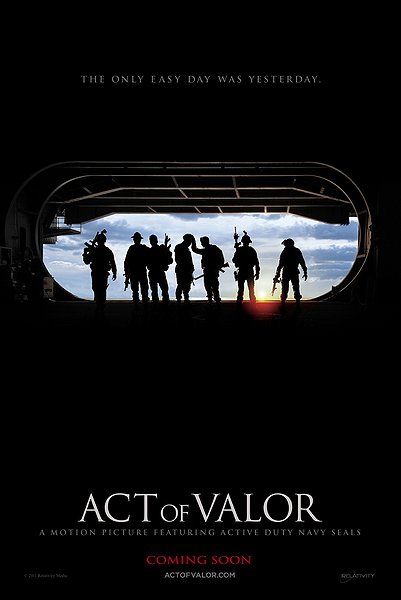
"Act of Valor" ** (101 minutes)
Thursday February 3, 2012
If you are thinking about enlisting in the Navy Seals (which, by the way, is the acronym for Sea, Air, and Land), boy, is this the film for you. However, if you are interested in being entertained by a movie which incorporates actual Seals standing in for professional actors, speaking a script that is as baffling as a foreign movie without subtitles, well, you might want to take in another flick at your local megaplex.
Co-directors Mike McCoy and Scott Waugh took 2 years to create what must have seemed like a good idea at the time: Use actual Seals and real bullets to put the viewing audience, as authentically as possible, into their boots.
However, there is a reason studios pay professional actors to put realism on the screen when millions of dollars are on the line. Unfortunately for them, acting is not a part of Navy Seal training. And, no matter how grandiose the action sequences are staged (and that is the only redeeming element in this mess), it is not enough to validate spending your time or money on what ultimately can be labeled a Military recruiting film.
The fictional story basically revolves around a plot involving terrorists aiming to bomb major U.S. cities. Various locales around the world are visited trying to tie all the confusing story lines together that, in the end, had me scratching my head while checking the time on my watch.
The action sequences are well staged (half of the budget must have been for bullets). However, the stilted "acting" using an inane script by screenwriter Kurt Johnstad (2007's "300") with the incessant use of indecipherable military technical jargon, is so overwrought that it eventually destroyed my focus and interest.
A rah-rah film for the good 'ol USA (the right-wingers will love this one), "Act of Valor" opens nationwide on February 24.

The Seals start their mission by air
"TINKER TAILOR SOLDIER SPY" OPENS JANUARY 6 IN BALTIMORE. SEE MY REVIEW PLUS Q AND A COVERAGE WITH DIRECTOR TOMAS ALFREDSON AND ACTOR GARY OLDMAN DIRECTLY BELOW MY REVIEW OF "THE ARTIST".
"The Artist" **** (104 minutes)

It has been 84 years since a silent film has won the Academy Award's Best Picture. 1927 also happened to be the first year the Academy gave out awards when actually two films were honored: "Wings" won "best production" as "the most outstanding motion picture considering all elements that contribute to a picture's greatness"; while F.W. Murnau's "Sunrise" was similarly honored as "the most artistic, unique and/or original motion picture without reference to cost or magnitude".
Come February 26, I predict that "The Artist" will finally break that streak. There has not been a movie this year that has even come close.
French writer/director Michel Hazanavicius has made a film that is truly one for the ages. At last count, it has garnered best picture nods from critics' groups in New York (both the New York Film Critics Circle and the New York Film Critics Online), Washington D.C., Boston, Las Vegas, and Indiana. In addition, it has received the most SAG and Golden Globe nominations. Last spring, Cannes awarded its top male acting prize to lead Jean Dujardin. Going in, I thought no way could this film meet my expectation. I was wrong. It was exceeded. And by a large margin.
The basic story is as old as cinema itself: George Valentin (French actor Jean Dujardin) is THE silent medium's biggest star. With his thin mustache and winsome smile, he is a physical compilation of Errol Flynn, Rudolph Valentino, Douglas Fairbanks, and Clark Gable, and easily brings to the screen bucket loads of charm and charisma. It is 1927 and he is at the top of his game.
The film opens with our hero proudly standing directly behind a giant movie screen, gazing up at the reverse images, while the audience in front is gloriously reacting to the premier of his latest creation. The smile on his face is as wide as the ocean. Meanwhile, Constance (Missi Pyle), his co-star, is standing in the wings, impatiently waiting for her introduction-all the while realizing that her popularity, not to mention her ego, is a far distant second.
On the red carpet afterwards, Peppy Miller, a shy attractive autograph seeker (perfectly played by the director's wife, Bérénice Béjo) is inadvertently pushed onto the walkway in front of the star as he is making his way out of the theater. When George willingly signs her book and then poses for photos, the paparazzi snap away with the resultant headlines screaming, "WHO'S THAT GIRL?".
Later on, after Peppy, an aspiring actress, lands a bit part with help from George, her career takes off. With the advent of talkies and George's subsequent refusal to embrace the new medium resulting in his firing by Kinescope Studios mogul Al Zimmer (a cigar chomping John Goodman), the stock market crash, and the dissolution of his marriage from his wife Doris (Penelope Ann Miller): George's popularity and financial empire start spiraling downward. The once proud and prominent star is soon left with nothing but his dog, Uggie (more on him later), his faithful butler, Clifton (the always dependable James Cromwell), and a tiny barren apartment.
The acting by Jean Dujardin must be singled out. His delicately expressive performance, balancing an over-the-top acting style in front of the camera while subtly transforming himself when dealing with his crumbling reality after the camera stops rolling, could easily win him an Academy Award. It is the best most complete performance I have witnessed this year.
Also, look for one of the most romantic scenes I have ever experienced in a darken theater when George first realizes his attraction for Peppy as they are shooting their first scene together. George slyly causes take after take to be shot so that he can slowly develop his enticement.
Although on the surface, the black and white movie appears to be a gimmick, it is actually a lovingly recreation, not a mocking, of the era. Hazanavicius has meticulously studied the medium to such a degree that he used film stock that would produce a grainier look. He even speeds up the film slightly by shooting at 28 frames per second instead of the normal 24, as it is projected on a nearly square screen in a 1.33 aspect ratio. Moreover, although this is a silent film, it is anything but. The amazingly lyrical score by Ludovic Bource, with a slight assist by composer Bernard Hermann from Hitchcock's "Vertigo" during a chase scene, beautifully "speaks" the universal language on the screen. Also, the eye-popping production design by Lawrence Bennett is also worthy of mention and Oscar consideration.
Finally, it's been a good year for dog actors: Laika (director Aki Kaurismaki's canine) in "Le Havre"; Cosmo the Jack Russell in "Beginners"; the Doberman and dachshund in Scorcese's "Hugo"; Skeletor the adopted greyhound in "50/50"; the bulldog in "Hipsters"; even Rowlf in "The Muppets"-just to name a few. However, Uggie, the Jack Russell terrier, is the scene stealer of the millennium and well deserving of this year's Cannes Palm Award. His crowd-pleasing performance only adds to the immeasurable charm this cinematic masterpiece has from start to finish.
It is one thing that director Michel Hazanavicius has so lovingly recreated the silent film and its era, but another to tie in a story and screenplay that will have you smiling, laughing, crying, sad, joyous, and practically dancing in your seat at various points throughout its running time. I am certain you will feel happier leaving the theater than when you came in, and that you will have a newfound appreciation and understanding as to why audiences around the world first fell in love with moving pictures a long long time ago.
The film started its limited release on November 25 and opens in Baltimore on December 23 on two screens at The Charles.

George (Jean Dujardin) meets Peppy Miller (Bérénice Béjo)
on the Red Carpet and pose for the papparazi

Doris (Penelope Ann Miller) reads about her husband's encounter with
Peppy the next day

George and Peppy

George and Uggie

George contemplating his next move after his downfall

Kinescope Studio mogul Al Zimmer (John Goodman)
"Tinker Tailor Solder Spy" (***-128 minutes)

(l to r) Actor Gary Oldman, Director Tomas Alfredson, and AFI Programmer
Todd Hitchcock at the AFI European Union Film Showcase closing screening of
"Tinker Tailor Soldier Spy"

Monday November 21, 2011
Off to Silver Spring to screen the closing night film of the 24th AFI European Union Film Showcase, "Tinker Tailor Soldier Spy" with an appearance by British actor Gary Oldman and Swedish director Tomas Alfredson (see coverage below following this review). Tomas' previous film was the outstanding 2008 coming-of-age vampire classic "Let the Right One In". (Although "Cloverfield" director Matt Reeve's 2010 U.S. remake "Let Me In" is admirable, it is nowhere as accomplished as the Swedish original.)
For his second commercial project, the director tackles John le Carré's 1974 bestselling spy novel that was initially made into a seven part, 350-minute BBC 1979 TV series starring Alec Guinness. And herein lies part of the problem: compacting the considerably dense spy novel into the 2 hour plus running time practically demands background knowledge of the story and a scorecard to keep track of the myriad of characters that comprise the wordy screenplay.
It is the 1970's Cold War and a British intelligent agent (Mark Strong) is killed in Hungary resulting in the firing of top agent George Smiley (a subdued but effective Gary Oldman in the Alec Guinness role) and his boss, Control (the wonderful John Hurt). However, Smiley is brought back in to uncover the Russian mole within the MI6 (the British Secret Service Intelligence agency-code named "The Circus") who was responsible for the assassination. With the help of Circus agent Peter Guillam (Benedict Cumberbatch) and field agent Ricki Tarr (Tom Hardy), Smiley ultimately narrows the Mole's identity to Percy ("Tinker"-Toby Jones), Bill Haydon (the well-dressed "Tailor"-Colin Firth), Roy Bland ("Soldier"-Ciarán Hinds), and Toy ("Poor Man"-David Dencik).
The incredibly talented cast is matched in mood through DP Hoyte van Hoytema's cinematography, and the intricate production design by Maria Djurkovic.
Those willing to devote their time and rapt attention, and not expecting any James Bond-like pyrotechnics and chase sequences, should ultimately be rewarded with an intelligent screenplay by Peter Straughan and his late wife Bridget O’Connor, as well as outstanding ensemble acting and production values. Just be certain that you have your have your fill of caffeine or else you might miss the spy thriller's climax.
The movie began a limited U.S. platform release December 9, including Washington D.C.

(l to r), "Poor Man" (David Dencik), "Tailor" (Colin Firth),
"Tinker" (Toby Jones), Control (John Hurt),
George Smiley (Gary Oldman), and "Soldier" (Ciaran Hinds)
Following the screening was an extended interview/question and answer session moderated by AFI Programmer Todd Hitchcock. In response to Todd's question as to what he saw was appealing about the role of George Smiley and what was the challenge that he had to figure out, Gary knew that Guinness had made the role so iconic so he tried to bring his own interpretation after reading the books. He pointed out that Alec was nearly 70 when he did the series, so there was that difference to explore. He realized they were mining the same material and that there were places that they both would meet. However, there were other shades to Smiley that initially presented the challenge of doing the role differently. Overcoming Guinness' towering performance, that for many was the definitive portrayal of the character, was a challenge-but gave credit to Alfredson for having great faith in him.
Todd then asked Tomas to explain how he went from making "an incredibly inventive vampire movie in Sweden" to pursuing John le Carree's spy material in the U.K. Tomas revealed that it was quite hard to explain why one accepts to start working on a project. However, he did say that when opening a script or, in this case a book, it is a very emotional thing. If he gets many images in his head and if he reacts very quickly, for example, crying, laughing, or his heart starts beating, for him, it is the big impulse he needs to accept a project. He also commented that he felt "Let the Right One In" was not a vampire movie but was a story about a young kid, and that this film was not an espionage film. For him it was about the soldiers of the Cold War, and that it was a very personal and emotional journey about relationships.
Todd pointed out that since the film is a 70's Cold War period piece, and asked if it had a contemporary resonate with the U.K. audience considering the film's tremendous popularity in that country. Gary responded that a great deal really has not changed over the years-other than the faces and the enemy and remarked that he personally gets the same kind of sensation watching the news today as he got when was fifteen-years-old.
Gary mentioned that he saw the original series but did not want to use it as a template or revisit it-that he did not want to be contaminated with an impersonation. He remembered it as "this big ghost that cast a shadow and I was terrified".
When asked by an audience member about a possible sequel covering the remaining books, Tomas replied that there might be one or two films in the future.
A question was raised as to why Tomas decided to use an old Julio Iglesias live disco version of "La Mer" over the last four minutes of the the action, which was contrary to the overall somber mood set throughout the movie. Tomas stated that during the scenes when George was listening to music in his apartment he thought about using a soundtrack that gave a glimpse of George's inner life. He eschewed the use of opera since the director thought of him as a romantic-which would be the total opposite of the life he lived in gray and dull England, and immediately he thought of Iglesias. However, Tomas did not use it there because "it would be a little too strange". However, he did find a rare vinyl recording of Iglesias' "La Mer" and decided to use it in the final scenes to "bring in a little fresh air" which would have the effect of "opening a window". He thought the song created that feeling, and that its use was not supposed to create a happy end feeling.
Gary was quizzed about his favorite role (he's been in over 60 films over the past 25 years!) and said it would be playing Lee Harvey Oswald (in Oliver Stone's 1991 film "JFK), stating that it was an exceptional experience because there was little of the character on the page. Stone instructed Oldman to thoroughly research Oswald to prepare him for the part. He also mentioned Tony Scott's 1993 action adventure "True Romance". Gary then added that he has jokingly said that he's been waiting over 30 years to play the part of George Smiley explaining that in the past he has played characters who physicalized their emotions and that it was a joy not having to express it in a physical way in this film.
When asked whether he plans to direct another film (he directed "Nils By Mouth" in 1997), Gary said he would like to but bringing up two boys has taken up a lot of his time. However, he said he was looking at a couple of projects and is hopeful he can direct one within a couple of years.
Todd then asked Tomas to explain how he went from making "an incredibly inventive vampire movie in Sweden" to pursuing John le Carree's spy material in the U.K. Tomas revealed that it was quite hard to explain why one accepts to start working on a project. However, he did say that when opening a script or, in this case a book, it is a very emotional thing. If he gets many images in his head and if he reacts very quickly, for example, crying, laughing, or his heart starts beating, for him, it is the big impulse he needs to accept a project. He also commented that he felt "Let the Right One In" was not a vampire movie but was a story about a young kid, and that this film was not an espionage film. For him it was about the soldiers of the Cold War, and that it was a very personal and emotional journey about relationships.
Todd pointed out that since the film is a 70's Cold War period piece, and asked if it had a contemporary resonate with the U.K. audience considering the film's tremendous popularity in that country. Gary responded that a great deal really has not changed over the years-other than the faces and the enemy and remarked that he personally gets the same kind of sensation watching the news today as he got when was fifteen-years-old.
Gary mentioned that he saw the original series but did not want to use it as a template or revisit it-that he did not want to be contaminated with an impersonation. He remembered it as "this big ghost that cast a shadow and I was terrified".
When asked by an audience member about a possible sequel covering the remaining books, Tomas replied that there might be one or two films in the future.
A question was raised as to why Tomas decided to use an old Julio Iglesias live disco version of "La Mer" over the last four minutes of the the action, which was contrary to the overall somber mood set throughout the movie. Tomas stated that during the scenes when George was listening to music in his apartment he thought about using a soundtrack that gave a glimpse of George's inner life. He eschewed the use of opera since the director thought of him as a romantic-which would be the total opposite of the life he lived in gray and dull England, and immediately he thought of Iglesias. However, Tomas did not use it there because "it would be a little too strange". However, he did find a rare vinyl recording of Iglesias' "La Mer" and decided to use it in the final scenes to "bring in a little fresh air" which would have the effect of "opening a window". He thought the song created that feeling, and that its use was not supposed to create a happy end feeling.
Gary was quizzed about his favorite role (he's been in over 60 films over the past 25 years!) and said it would be playing Lee Harvey Oswald (in Oliver Stone's 1991 film "JFK), stating that it was an exceptional experience because there was little of the character on the page. Stone instructed Oldman to thoroughly research Oswald to prepare him for the part. He also mentioned Tony Scott's 1993 action adventure "True Romance". Gary then added that he has jokingly said that he's been waiting over 30 years to play the part of George Smiley explaining that in the past he has played characters who physicalized their emotions and that it was a joy not having to express it in a physical way in this film.
When asked whether he plans to direct another film (he directed "Nils By Mouth" in 1997), Gary said he would like to but bringing up two boys has taken up a lot of his time. However, he said he was looking at a couple of projects and is hopeful he can direct one within a couple of years.

"The Descendants" (** 1/2-115 minutes)

Wednesday November 9, 1011
Alexander Payne's success performing double duty as a director and screenwriter has clearly placed him in my elite category. His four previous films include "Citizen Ruth" (1996), "Election" (1999), "About Schmidt" (2002), and the phenomenal "Sideways" (2004) which would have been my pick for a Best Picture Oscar. Each successive film has gotten better and better.
Therefore, after a long seven-year hiatus, my anticipation and expectation gauges were nearly off the charts when I went to screen Payne's latest. I suppose there was really nowhere to go but down (excuse the pun) after "Sideways", which might help explain my overall disappointment.
George Clooney (extremely busy this year with his third release) plays successful real estate lawyer Matt King, a descendant of Hawaiian royalty, whose wife lays in a hospital, comatose from a boating accident. We quickly learn that their marriage was already on shaky ground, made shakier when his eldest daughter Alexandra (Shalene Woodley in a performance that will surely put her in running for Best Supporting Actress) reveals to Matt that her mother was having an affair with a local real estate mogul (Matthew Lillard). Payne proceeds to juggle a number of plot lines:
- Matt's chagrin (he calls himself "the backup parent") of now having to care for his precocious daughters Alexandra and Scottie (pre-teen Amara Miller)-a task previously handled exclusively by his wife.
-the decision to pull-the-plug on his brain dead wife
-his search for his wife's lover
-Matt, as the main executor of his family's trust, must decide on the winning bid for 25,000 acres of prime beachside property that has been in his family since 1860.
Payne, along with his co-writers Nat Faxon, and Jim Rash have adapted Kaui Hart Hemmings' 2007 novel to produce a darkly comedic script that is uneven and ultimately uninspiring-which is a problem when dealing with the nearly two hour running time. Clooney's somewhat droll ineffective voiceover narration in the beginning is, thankfully, dropped a quarter of the way through. Also, although Clooney tries his best to portray the full range of emotions as he threads his way through the myriad of crises, I never found myself as connected and involved as I was with Payne's other films. Sid (Nick Krause), Alexandra's boyfriend seems out of place here and would be more at home in a Judd Apatow comedy. Finally, Payne's saturating nearly every frame with native music will either have you enthralled or annoyed depending on your musical tastes. Put me in the latter category.
On the plus side, there is a terrific supporting role by the wonderful Robert Forster as his cantankerous father-in-law and, visually, the film is a loving post card of Hawaii. However, in the final analysis, the drama didn't grab me and ultimately left me cold.
"The Descendants" has platform openings beginning November 18 (including DC) and a November 23 Baltimore opening.

(l to r) Alexandra King (Shailene Woodley), Matt King (George Clooney),
Scottie King (Amara Miller), & Sid (Nick Krause)
"The Man Nobody Knew" (*** 1/2-104 minutes) + Interview with director Carl Colby

What everybody knew was that the slight William Colby (hardly the prototype as a James Bond-type poster child) was appointed in 1973 by then President Nixon to be the 10th director of the Central Intelligence Agency, until President Ford replaced him with George H.W. Bush in 1976 in the aftermath of the Watergate scandals. We also knew that he died in 1996 at the age of 76 when his body was discovered on the shores of the Potomac eight days after embarking on a solo canoe outing. However, other than his public service record and achievements, as the title of Carl Colby's title conveys, nobody really knew the man.
Emmy Award winning documentary filmmaker Carl Colby, William's eldest son, tries to enlighten the world on the enigmatic persona who seems to have had a single-minded life purpose, personally trying to better this country's interests around the world. Carl's comprehensive exposé, for the most part, succeeds as best he can to convey what made his father tick by interspersing two aspects of his life: his public service and his family life outside the spotlight. However, what we end up with is possibly more questions about the senior Colby than when we had going in.
His career as a real life spymaster, (referred to by the cumbersome subtitle, "In Search of My Father CIA Spymaster William Colby") begins as an OSS officer who trained for missions parachuting into Nazi-occupied Europe. This eventually led to his involvement with post-war covert operations such as the alliance with The Vatican in the late 1950's to remove the Communist Party, heading the CIA in the Far East during the Vietnam War buildup, overseeing the coup & the assassination of Vietnam’s President Ngo Dinh Diem in 1963 Saigon, and becoming the man in charge of the controversial Phoenix Program during the Vietnamese War 1967-1972. This latter program put the term counterinsurgency into our vernacular. His patriotism and tenacity led to his appointment as Director of the CIA-only to see it all explode in 1975 when he defied the President after taking the higher moral ground by revealing to Congress the agency's darkest secrets.
However, the more fascinating aspects of the documentary are the private intimate moments including photos and footage only a family member could provide. The personal history includes, what at first, appears to be an idyllic life when the family settled with him in Italy. However, later in William's career, after recognizing the inherent dangers his family faced (Carl remarks as a young child he at times heard bombs exploding in the distance outside of town)William chose to continue his oversea assignments alone, leaving his family, including his devoted wife Barbara (whom he later divorced after 40 years), behind in the states. We also learn that it was up to Barbara to care for Carl's sister who suffered from epilepsy and anorexia nervosa which led to an early death in her twenties. William avoided his daughter's care and illness, having no patience for her condition. He seemed to have carried this guilt throughout his life.
The rare archival footage incorporated throughout is nothing short of stunning. The clarity of the film stock is totally devoid of scratches and literally jumps off the screen. Carl supplies over 80 interviews with family, former colleagues, prominent government & media members (including former National Security Advisers Brent Scowcroft and Zbigniew Brzezinski, former Secretary of Defense Donald Rumsfeld, former Secretary of Defense and Director of CIA James Schlesinger, as well Pulitzer Prize journalists Bob Woodward, Seymour Hersh, and Tim Weiner) in his attempt to complete a knowing portrait of his father. Although, the sheer number of talking heads tends to bog down the proceeding, overall, this is an impressive work that tries to humanize as much as possible a stalwart Government servant & patriot who ultimately became an indirect casualty of the Vietnam War but whose service to the country was immeasurable.
The film opened October 14 at L.A.'s Nuart Theater and October 21 at the Gene Siskel Film Center in Chicago. It begins a run at Washington's D.C. E Street Theater & Fairfax Va.'s Cinema Arts Theater on October 28, after which it platforms in other theaters around the country.
------------------------------------------------------------------------------
INTERVIEW WITH DIRECTOR CARL COLBY:
Carl Colby has been involved with over 40 documentaries that have taken him all over the world with assignments in over 30 countries. His films have covered a wide array of subjects including films about Franz Kline, William de Kooning, Bob Marley, Frank Gehry, George Hurrell, and Franco Zeffirelli-the latter of which won an Emmy Award for the 1984 PBS production "Zefferelli's Tosca". Among his numerous career achievements were producing and directing films covering Mardi Gras ("Fat Tuesday" which won Best Film at the USA Film Festival); Washington artist Gene Davis; & musical performance films on Kid Thomas Valentine and the Preservation Hall Jazz Band, Clifton Chenier and his Red-Hot Louisiana Band, and Clarence "Gatemouth" Brown. He also produced a TV version of the Obie Award-winning musical "One Mo' Time!". His interest in space exploration resulted in his producing and directing the award-winning film "Voyager: The Grand Tour" which won First Prize at the 3rd International Animation Festival in Hiroshima, Japan.
During the interview Carl gave credit to producers Grace Guggenheim, daughter of the late great filmmaker Charles Guggenheim, and David Johnson for pushing him to be more personal and to try and reach further-which was hard for him but realized in the end it was necessary. In addition, he told me he decided not to put more of himself in the movie. That it was a conceit he did not want to do. "If you see me now, you'd see that I'm kind of a settled OK looking guy. But how could I pull that off in the movie? I want to be the 8 year old who adores his dad in the beginning. I want to be the 12 year old who later hears rumbles coming from 30 miles in the outskirts of town and I'm beginning to get kind of worried. I want to be the guy who's 17 years old hearing people call my father a war criminal. I want to grow up in the course of the film. That's one of the secrets, the techniques that I think the film pulls off without people being aware of it."
On commenting on his career over the years making documentaries about interesting personalities and why it took him so long to point his camera at his father, Carl remarked that he realized early on he would be fine if he talked with him about Gorbachev, Putin, Chechnya, or the drones-he would have an opinion and it would be very interesting, "but he wouldn't go into the emotional zone. He would say 'that's your department, friend'. Or if I asked him why did you divorce my mother. He would just wave it off like not say anything. So it would be very frustrating. So only afterwards when he died that I thought well maybe I got license now. I'll approach it from the underneath."
JB: How long did the project take you to complete from start to finish?
CC: It took about 5 years. I started thinking about it about 10 years ago while I was watching CNN's coverage of 9/11 and I saw Wolf Blizer interviewing James Baker two hours after the towers fell. He asked Baker how did it happen and Baker said that he traced it directly back to the Church and Pike Hearing back in the 70s when William Colby the CIA Director was forced to reveal the CIA's "Family Jewels", which led to the dismantling of America's and the CIA's ability to conduct clandestine action and covert activity-sort of endangering America. I thought, wow, that's pretty interesting. My father's been dead five years and it seems like he's relevant. And then, 2 weeks later I see photographs of CIA operatives sporting beards and wearing turbans and riding camelback & horseback with The Northern Alliance in Northern Afghanistan against the Taliban-and I thought well that's like the OSS. I then thought that maybe there's a story here. So I started more as a professional profile of my father because I do more profiles of individuals and I thought maybe that's an angle. And then I interviewed my mother and everything changes.
JB: You elicited commentary from an extensive list of about 85 individuals ranging from top government officials, CIA employees, the media, and, as you mentioned, your mom who puts a softer human light on your father's personal life outside the CIA. Were any of these participants harder than others to convince to be interviewed?
CC: Well, I took it very seriously that this is my one shot. If you ask somebody like James Schlesinger, who you might know from your family but who's not going to otherwise give you an interview, when I went to pre-interview him , I'd better know what I'm talking about. So for the CIA and in a project like this, I have to know something in order to get something. So, I did a lot of reading and researching which has kind of been a hobby of mine my whole life, reading about current affairs and international relations. I was pretty versed in the flow of the dialogue of the conversations about these things. So, I did a lot of homework spending about a day and a half, two days writing each Email invitation, researching what I would I ask these people and then I'd put it in the Email. A small group said sure I'll talk to you. I knew your dad. Usually that was the old guard CIA people. The current CIA people or the top journalists and others-they wanted to see that I had some substance here; what was I up to and was I up for this task. Tim Weiner, someone like that. I have to know my game. Then I think they perceived that I was going to do something serious so they participated.
JB: Were there any public figures you actually wanted to interview but who refused to cooperate?
CC: Well, nobody in particular refused. I just sort of had a hard time connecting with Dick Cheney. His office was very interested but he was writing his book, or he had another heart attack, or had some heart issue. So that sort of derailed that for a while. And President Bush and Henry Kissinger I just had continuing dialogues with and it just never came to past because the film takes a certain direction and at some point you go after interviews that are serving your story and that are serving the narrative in your writing and making.
JB: Did you encounter any type of government resistance while making the film?
CC: No, not at all. I had no secret access or any privilege access to CIA or anyone else and I obviously made it very clear from the beginning that this is no exposé. I not interested in revealing classified secrets or documents or anything of that sort, or operations, or any one's names. I just basically asked for what the normal American citizen would ask for and took it from there.
JB: Near the end of the film, you narrated that after your dad left the CIA he could be crueler than anyone you ever knew. Can you elaborate on that statement?
CC: He lived at the tip of the spear. He had a mission. He was very serious. He could be serious. He could be friendly. He was the opposite of The Great Santini. I mean, he was not a bombastic, competitive, physically brutish character-not at all. He was kind of affable and quiet and would have a discussion with you. And he would write to me and I would write back to him cordially. What I think I meant by that was that I just don't think that he operated in the emotional zone. It's just not his territory.
JB: So emotionally, he was cruel.
CC: No, I wouldn't say that. He's just not operating in that zone. And I think he had a very low boiling point. So he could absorb pain, an intense amount of pain, and he could inflict pain. And I don't mean that in a very negative way. I just think that he was a warrior. And he had a job to do and he did it very well. There are warriors now: General James Mattis , or General John Allen, or a number of other generals I can name out in Afghanistan today who are fighting the battle. Would I say that they were mean? I wouldn't necessarily say always that way but there is a cruelty in a way that when you accept loses and when you are able to withstand loss. Most people fold. Most people can't take it. He was always quoting Truman: "You can't take the heat, get out of the kitchen". His kitchen was white hot, and he wasn't leaving the kitchen.
JB: And that comes across in the movie.
CC: He was one of these guys, I don't know if you ever feel like you're in danger or whether you feel the necessity to do this, but some people carry around a phone number or two that they're going to call, if something happens. Like, whom are you going to call? Well, I think if you knew him, I think you'd want his phone number in your wallet.
JB: Did you ever hear your father commenting how he felt about Bush Sr. succeeding him at the CIA? Did he ever have an opinion about that?
CC: I think initially he thought that Bush Sr. was a very effective unifying force in a way that helped the agency. That he took on the mission of the individual officers. He rallied around them and tried to support them and cast them in a positive light-in a sense sold the CIA back to the Congress. He tried to rally support for the mission of the CIA even though it started to be decimated by that time. Basically, the gate was up. I mean the Congress had had its fill of the CIA and wasn't going to fund much of it. And that was actually a pretty treacherous time. I mean the mid 70s was not a hay day for the CIA and for America. We'd just lost the war in Vietnam. The Russians were ascendant; they were threatening us. There were 30,000 Cuban troupes in Angola. The Caribbean was kind of in flames. Latin America was starting to bubble up. South America was kind of up for grabs. Most of Africa was kind of in play. And the oil crises was hitting. And, so it wasn't a really strong time to be an American.
JB: You included an enormous amount of amazing archival footage. And I was really impressed with the pristine quality of the images-devoid of the usual scratches and imperfections you usually get with such stock footage. Did you go to any special lengths to clean up these images?
CC: One of the luckiest most fortunate things that happened to me is that I allied myself with Grace Guggenheim as my archival producer and one of our key producers. And she is the queen of the archival footage. Her father's legacy is extraordinary-he made not only heartfelt and beautiful films but very simple films. From a film standpoint, I learned from him. Grace set about really ferociously combing the National Archives and a lot of commercial sources for the best possible footage. She did a super human job from everything down to the transfers to the no scratches-just doggedly going after the very very best. Particularly the stills and how we animated the stills-just everything. It just looks gorgeous on screen. And then we decided at the end, thanks to our main producer, David Johnson, to go ahead with the 35mm transfer. And the sad part is that I worry about what is happening to history and what's happening to those films, which are few and far between. We paid every possible right. We did everything correctly in terms of royalty payments and rights payments and clearances worldwide and we got the best possible transfers. I worry that people are either not using this footage or that they're stealing it and putting on YouTube. It's kind of sad in a way that we're losing our history. And I would give a huge amount of credit to Grace and to her father because of the example that her father set. He's probably the finest filmmaker of his generation not only in documentary, but one of the finest filmmakers of the century.
JB: You did a great balancing act between showing the business side of your dad and the personal side, which is a hard juggling act.
CC: That was one of the hardest things. You really tapped into exactly the right film question. That was the toughest thing. Frankly, I couldn't let 45 seconds go by or more without bringing my father back into the story. People say to me how come you don't have anything about the Korean War or how come you don't have about what happened in XYZ? I said, well, he's not involved with that. It's a tangent. It's like you're on a freight train from New York to Philadelphia and all of a sudden it takes a left turn to Atlantic City and all of a sudden you're lost.
JB: This might explain why it took you 5 years to get it all together.
CC: Exactly.
JB: Finally, are there any more theatrical films in your future?
CC: I tapped into some interesting arenas here so I'm going to look at that and there are a couple of other documentaries that I'd like to do. I'm working on a book that would come out with the release on TV & DVD late next year. That's kind of the next step. And then I'll try to launch one of these other projects.

William Colby testifying before Senate Church committee
in 1975

(l to r) Catherine, Barbara, William, Carl and Jonathan Colby
Subscribe to:
Posts (Atom)
