The ten year run of the premier documentary film festival known as SILVERDOCS is no more. The long-time major presenting sponsor, Discovery Channel, has bowed out and replaced by Audi - and with it came some major changes for 2013. Besides the obvious name change, the festival was reduced from six days to five and the venues were expanded into the metropolitan D.C. area for the first time allowing easier access for film goers in the D.C. and northern Virginia suburbs. Also new were the "AFI Catalyst Sessions: The Art of Moving Reality" which served to create a dialogue between filmmakers and our nation's leaders on many of the controversial issues raised by several of the films. Gone were the plethora of awards handed out to deserving filmmakers-replaced with just two Audience Awards for Best Feature film and Short film; as well as the numerous conferences held at the main hub: The AFI Silver Theater in Silver Spring, MD. Although I lamented the loss of having the totality of the fest surrounding the AFI Silver Theater, there is a certain excitement of having our elective officials included in the discussions raised by these documentarians. Finally, despite the changes, the constant of having Festival Director Sky Sitney and her staff remain on the scene is a definite plus. I screened seventeen of the fifty-three films (chosen from 1,929 submissions) and each were worthy of my time. My main suggestion to the organizers would be to provide a shuttle service next year for attendees who want to attend films both in Silver Spring and D.C. in order to avoid the usual traffic and parking nightmares.
TOP 3 AT THE 2013 AFI DOCS
(1) "Wrong Place Wrong Time"
(2) "Let the Fire Burn"
(3) "Blackfish"
Below are the reviews in alphabetical order of the 17 films I screened followed by coverage of annual The Guggenheim Symposium honoring Errol Morris and festival snapshots. (NOTE: The Audience Award for Best Feature went to "The New Black" by director Yoruba Richen and the Audience Award for Best Short went to "Slomo" by director Josh Izenberg-neither of which was screened by this critic.)
"The Act of Killing" (***1/2 out of 4 - 122 minutes)

Anwar Congo (r) preparing for his scene reenacting a murder
"After Tiller" (*** out of 4 - 85 minutes)


Dr. Warren Hern, one of the featured late-term abortion doctors

(l to r) Co-directors, Martha Shane and
Lana Wilson

(l to r) Co-directors, Martha Shane and
Lana Wilson
"American Revolutionary: The Evolution of Grace Lee Boggs" (***1/2 out of 4 - 82 minutes)
When Korean American director Grace Lee began a search of notable Asian American women bearing her name, she discovered feisty 97-year-old Detroit-based Grace Lee Boggs and structured a film around one of the most extraordinary woman of the 20th century. Boggs is a Chinese American philosopher (she's a proponent of Marx and Hegel) and social activist in the Civil Rights and Black Power movements (Angela Davis stated in the movie that she, "has made more contributions to the black struggle than most black people have”). The film maker expertly interweaves archival footage of her life and the horrid conditions and inequities she fought against on behalf of Blacks while living in Detroit. Her views that revolution begins with individual transformation is a constant theme presented throughout. The East Coast premiere of this fascinating profile recently won the audience award at the Los Angeles Film Festival.


Director Grace Lee and son
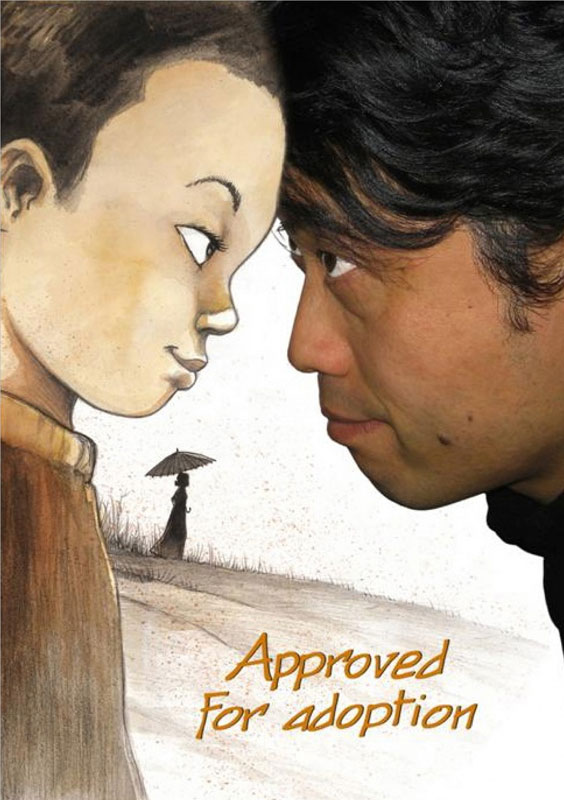
"Approved for Adoption" (***1/2 out of 4 - 75 minutes)

This is a slight but very entertaining French doc by directors Jung Henin and Laurent Boileau which focuses on the life of graphic novelist Jung, one of over 200,000 Korean children adopted in the 1950's after the Korean War. The film's major theme deals with Jung's constant adjustment and yearning to belong while growing up in a multicultural family and community. Jung has always been in search of his identity while growing up in a Belgian family with four siblings. Effective animation by Jung (3D figures are used against a 2D background) aptly describes both humorous and challenging episodes during his adolescence which alternates with live footage of his return to Korea in an effort to connect to his roots and heritage.

Director Laurent Boileau (l) and Jung
"Blackfish" (**** out of 4 - 82 minutes)

This riveting true-life horror story by director Gabriela Cowperthwite is another disturbing exposé of man's inhumanity to one of nature's most exquisite creatures. In general, the documentary focuses on the insane practice of capturing "killer whales" to live 24/7 in a "bathtub" in sea parks in order to entertain for profit. In particular, the director concentrates on a 12,000-pound bull orca named Tilikum who was responsible for the 2010 death of SeaWorld trainer Dawn Brancheau as well as two other people during his over 20 year existence in theme parks. Ironically, although labeled as "killer", these animals have never been known to harm a human while living free in the wild. Revealing interviews and startling never before seen footage help to hammer home the cruelty we are inflicting on these majestic highly intelligent animals, and helps to debunk many of the myths perpetrated by the owners of these parks. Expert editing by Eli Despres plus a wonderful score by Jeff Beal makes this film one of the most important works I have ever viewed on screen. The film opens on a limited theatrical run beginning July 19.

Tilikum

Former Sea World Trainer Samantha Berg
and associate producer Tim Zimmermann

Former Sea World Trainer Samantha Berg
and associate producer Tim Zimmermann
"Gideon's Army" (**** out of 4 - 96 minutes)

The subjects of this excellent HBO-produced documentary are a group of idealistic public defenders in the South who struggle to perform their thankless job despite enormous caseloads, long hours and little remuneration. The title refers to Clarence Earl Gideon whose 1961 conviction, without counsel, for stealing a soda and a couple of dollars from a pool hall in Panama City led to the landmark 1963 Supreme Court decision granting the right to counsel in every criminal court case. Although there are 12 million people arrested each year in the U.S., most will need one of only 12,000 public defenders available. Director Dawn Porter lets the cameras roll, sans narration with a minimal soundtrack, as she concentrates on three of these lawyers. Each juggles an outrageous number of cases, representing folks the majority of which they feel are guilty, while sacrificing their personal lives and, in some instances, even their sanity, to perform an often thankless service. This is an extremely affecting film that will likely change your perspective of our judicial system while better appreciating this army of warriors who tirelessly serve to protect our liberties. Matthew Hamachek's expert editing won the Editing Award at this year's Sundance Film Festival. "Gideon's Army" began a limited theatrical run on June 28 in New York before premiering July 1 on HBO.

Public defender Travis Williams

(l to r) "Gideon's Army" subject Jonathan Rapping, subject
June Hardwick, co-producer Summer Damon, subject Brandy
Alexander, director Dawn Porter, and subject Travis Williams.

(l to r) "Gideon's Army" subject Jonathan Rapping, subject
June Hardwick, co-producer Summer Damon, subject Brandy
Alexander, director Dawn Porter, and subject Travis Williams.

(l to r) Director Dawn Porter, and subjects Travis Williams,
Jonathan Rapping, June Hardwick and Brandy Alexander
Philadelphia's law enforcement had been dealing with the back-to-nature militant African-American group MOVE for years-especially after a police officer was killed in a 1978 confrontation in which nine members were convicted despite their denials. Conversely, no officers were convicted when a MOVE member was later brutally beaten-despite video evidence. After the group moved to a middle-class neighborhood, erected a roof bunker, and continuously caused disturbances, this explosive situation came to abrupt end. On May 13, 1985, in an attempt to remove thirteen members (including children) from their row house, police fired 10,000 rounds at the house and dropped C-4 explosives on the roof. The result: nine MOVE members died (including 5 children) and 61 homes across several city blocks burned to the ground-especially after the order was made to firefighters to "let the fire burn". Director Jason Osder brilliantly recounts this horrific event. Using archival footage including TV and witness accounts, the resultant investigative committee proceedings, and the disposition by a 13-year-old survivor, he dramatically weaves its narrative with precise editing by Nels Bangerter (the doc won the Tribeca Film Festival Editing Award) and a wonderful score by Chris Mangum. A disturbing look into a rampant police culture replete with racism and corruption that would be repeated eight years later in Waco Texas where authorities decided to eliminate a group instead of peacefully bringing them to justice without bloodshed.

61 row homes burning in Philadelphia on 5/13/85
"Letters to Jackie" (*** out of 4 - 88 minutes)

The opening night film is a world premiere and a loving tribute to a long lost innocent era of our country when it was headed by the youngest president ever elected. The week after John F. Kennedy was assassinated, the First Lady received 45,000 letters from a grieving nation. Seven weeks later, that number grew to 800,000 and would finally top off at 1.5 million. Academy Award winning director Bill Couturie (1989's "Common Threads: Stories from the Quilt") based his film on "Letters to Jackie: Condolences of a Grieving Nation," by Ellen Fitzpatrick, who researched for her book many of the 200,000 existing letters in the Kennedy Library. For his film, Couturie utilized 20 top Hollywood actors to voiceover a number of these poignant correspondences which provides a snapshot of America and its citizenry during one of its darkest hours. Somewhat disjointedly interspersed with the readings are public and private imagery during Kennedy's brief 1,039 days in office. And although not all of these events are sugar-coated (the Bay of Pigs fiasco is mentioned, e.g.), you will not see any references to his alleged womanizing. Instead, Couturie mainly succeeds in capturing a mood of a nation distraught about the end of Camelot. The Stephen Spielberg-produced film will air on TLC this fall honoring the 50th anniversary of Kennedy's death.


"Life According To Sam" (**** out of 4 - 93 minutes)

Yet another superlative HBO-produced documentary that is heartbreaking, heartwarming, and, ultimately, optimistic. Directors Sean Fine and Andrea Nix Fine (who directed the wonderful 2007 Oscar nominated doc "War Dance") tackle the rare devastating disease, progeria. Afflicted children (only one in several million will have it with about 250 existing worldwide) suffer accelerating aging and often die by age 13 of stroke or heart attack. The bad news: Sam Berns was diagnosed before age two. The good news: his parents are physicians determined to raise money to first identify the gene responsible for the disease and, when accomplished, develop an experimental drug to combat it using progeria children from 16 countries for their study. Sam is already thirteen at the start the film so it becomes clear that Leslie and Scott are facing a race against time to head off their son's certain premature death. The Fines brilliantly amp up the suspense throughout while constructing a wonderful profile of Sam as an intelligent lad who, like any normal teenager, loves sports and music while facing his predicament with incredible elegance and courage. The film is scheduled to premiere on HBO sometime this fall.

(l to r) Dr. Leslie Gordon, Sam Berns and Dr. Scott Berns

(l to r) Sam's dad Dr. Scott Berns, editor Jeff Consiglio
and directors Sean Fine and Andrea Nix Fine

Sam and mom Dr. Leslie Gordon appear via Skype to
answer questions from the audience after the screening

(l to r) Sam's dad Dr. Scott Berns, editor Jeff Consiglio
and directors Sean Fine and Andrea Nix Fine

Sam and mom Dr. Leslie Gordon appear via Skype to
answer questions from the audience after the screening
"Lost For Life" (***1/2 out of 4 - 75 minutes)
The world premiere of Joshua Rofé's film commendably debates the question of whether juveniles should receive life sentences without parole-despite the possibility of their redemption after serving years in prison. Certainly there are instances where such sentences seem appropriate, such as the onslaught of mass school killings by disturbed teens in recent years. However, as the director points out, there are other cases where life without parole can be inappropriate at best and inhumane at worse. We are shown two teens who, for kicks, plotted and killed a female schoolmate. Reminiscent of the infamous 1924 Leopold and Loeb case, the heinous crime will garner little sympathy for the fate of the two perpetrators. However, the argument for life without parole becomes much more blurred when we are introduced to an adult who was a gang member when convicted at age 17. He not only has shown noticeable remorse but is also totally involved in helping others avoid the mistakes he made when he was a juvenile. (This individual ended up being paroled by the governor after serving 20 years.) Other examples are provided as well including a scene of a poignant support group of relatives of convicted juveniles, which further adds to the complexity of the subject. To his credit, the director makes no final judgments but leaves it up to the viewer to decide this issue that has no definitive answers.

A juvenile lifer profiled in "Lost for Life"

(l to r) Producer Mark Jonathan Harris, editor
Jason Rosenfeld, producer Rick Allen and
director Joshua Rofé
Jason Rosenfeld, producer Rick Allen and
director Joshua Rofé
The life and career of renowned British photojournalist Don McCullin is given a glowing tribute by directors Jacqui and David Morris who document McCullin's harrowing exploits while
photographing wars on three continents. The photographer put himself on the front lines of conflicts in Vietnam, Biafra, Cambodia, Northern Ireland and the Congo to chronicle the utter horrors of wars for the rest of the world-often risking his life in the process. Working for the Sunday Times from the 1960's to the early 80's, McCullin, now 77 years old, expounds on his craft and relates his intimate thoughts behind the images he recorded. Concurrently, the screen fills with his incredible pristine photos of war and the devastating human suffering it creates. Although the doc covers his early years growing up in an impoverish neighborhood in North London, I would have liked some more insight into his personal life as an adult away from the battlefields. Despite that, this is an insightful portrait of one of the finest war photographers of the 20th century that offers amazing images that you will not soon forget.
Don McCullin

Director Jacqui Morris
"Mistaken For Strangers" (**1/2 out of 4) - 80 minutes
Director Jacqui Morris

Tom and Matt Berninger are brothers. That is where the similarity ends. Matt, married with children, is the older brother (by nine years) and is the pensive charismatic lead singer of the semi-famous indie rock group The Nationals-a Cincinnati band that formed in 1999 . Oafish Tom is an aspiring director who still lives at home, loves to party and listen to heavy metal. While Tom has made some grade C horror flicks, it is clear that his future life path is still to be determined. All that appears to change when Matt asks Tom to be a roadie and to film the group while they embark on a year-long tour. This endeavor becomes humorously disastrous at every step of the tour as Tom keeps pissing off the band's handlers. He continually drinks and screws up his simplistic roadie duties while getting inane interviews and filming the band at its most awkward moments. The result: Tom's fired midway through the tour. More a family profile than a music documentary, director Tom does manage to film some all-too-brief satisfying musical snippets of the group. In fact, one downside is that more extended versions were not included as it is clear that the Nationals are indeed talented. However, some of the humor is forced and staged-but in the end, Tom does appear to have more promise as a film maker then he lets on. The doc is not to be missed by true fans of The Nationals, but if they are expecting to see extended concert footage, they might be a tad disappointed.

(l to r) Matt and Tom Berninger

Director Matt Berninger
"Our Nixon" (**** out of 4 - 85 minutes)

Whereas "Letters to Jackie" (reviewed earlier) gloried JFK as one of this nation's most endearing presidents whose assassination was almost universally mourned by its populace, here comes a portrait of this our country's most corrupt and despicable leader. Although the nation has wallowed through the muck known as Watergate emphasized by Nixon's own secretly recorded White House tapes, Director Penny Lane obtained recently released never-before-seen super 8 home movies shot between 1969-1974 by close Nixon aides H.R. "Bob" Haldeman, John Erlichman, and Dwight Chapin which were confiscated and vaulted away for over 40 years by the FBI. Lane culled through over 500 reels of silent film and, with editor Francisco Bello, has expertly interwoven interviews, rare archival footage, TV bites, and, yes, portions of those infamous audio tapes, that illustrates a President as a total control freak bigot (his take on Archie Bunker and the enormously popular TV show "All In The Family" is laugh-out-loud priceless) whose stupidity ultimately led to his personal and professional downfall. Lane also infuses original music by Hrishikesh Hirway to round out the production of a film that will hold your interest throughout. Winner of the Grand Jury Prize for Best Documentary at the Seattle International Film Festival, "Our Nixon" is scheduled to be shown on CNN in August and have a limited theatrical release on August 30.
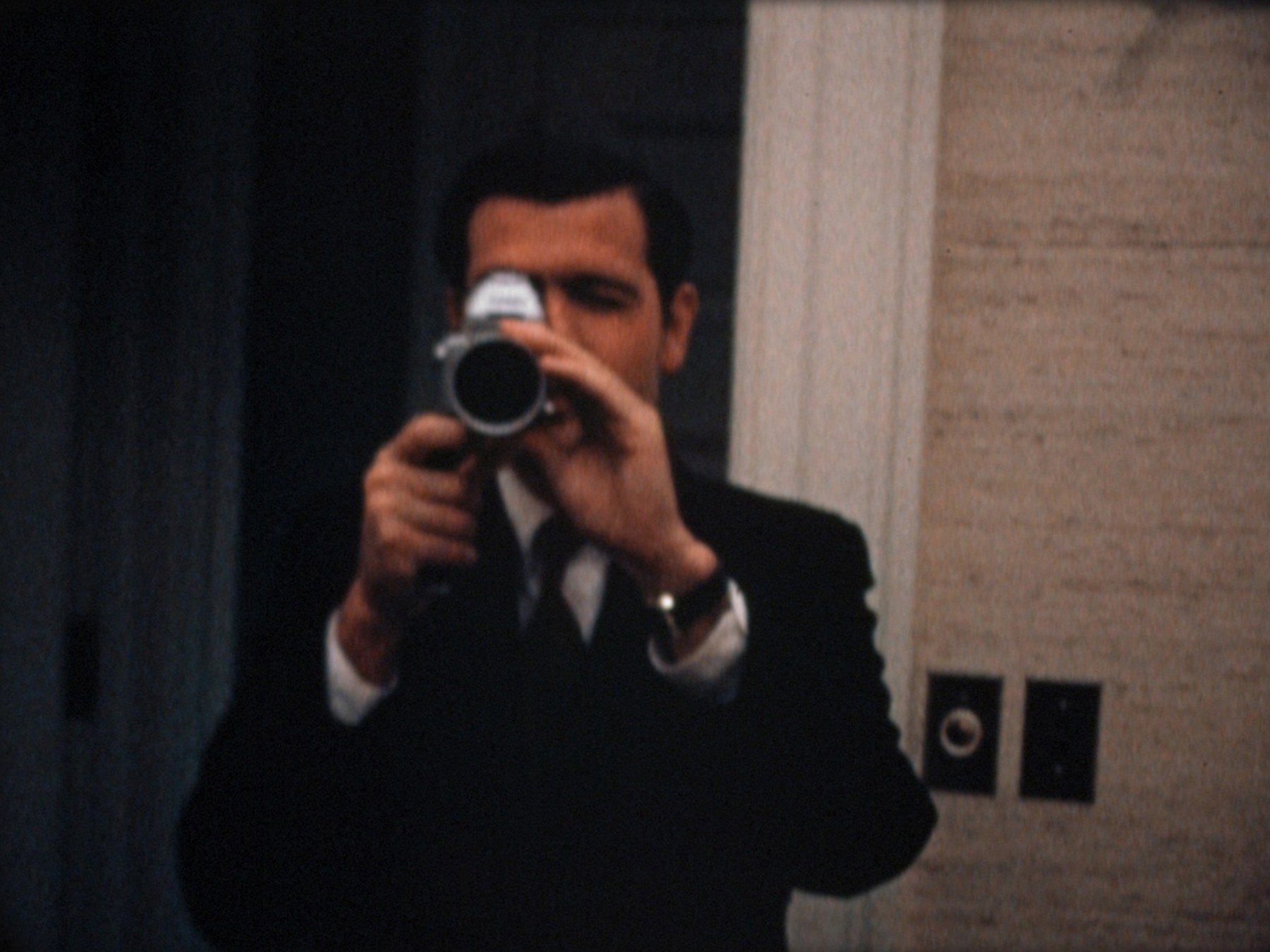
Special Assistant Dwight Chapin films Haldeman
filming him at the White House on the night
of the Apollo 11 moon landing (July 20, 1969)
"Running From Crazy" (**1/2 out of 4 - 100 minutes)

Director Barbara Kopple won Academy Awards in 1976 ("Harlan County, USA") and 1990 ("American Dream") tackling hard hard-hitting subjects. She attempts similar audience involvement here but comes up short in this uneven doc connecting the mental illness dots in a famous family line with a distinct history of the disease that includes seven suicides. The center of the film is actress Mariel Hemingway who gives candid interviews elucidating her family history that includes her late famous grandfather, Ernest, and her two older siblings, Margaux and Muffet-the former, a 70's supermodel and actress who committed suicide in 1983 and the latter, who resides in a home suffering from bipolar schizophrenia. Certainly, the main focus is important and worthy of a documentary; however Kopple leaves too many questions unanswered. The most startling revelation, that Mariel mentions possible sexual abuse by her father, comes out of nowhere and then leaves just as quickly with no explanation or clarification. Other segments (for example, a scene recording a fight between Mariel and her boyfriend during a rock climbing trip in the desert) seem out of place and irrelevant to the much larger issues underlying the film. What could have been an uncompromising investigation instead leans more towards a Hollywood biopic fluff piece that suffers from a lack of focus and tight editing. A disappointment from one of our foremost documentary film makers. The Oprah Winfrey-produced movie will air on Winfrey's OWN channel later this year.

Mariel Hemingway and her partner, Bobby Williams
during their rock climbing trip

Director Barbara Kopple
during their rock climbing trip

Director Barbara Kopple
"Teenage" (*** out of 4 - 78 minutes)
"Teenage" is more a pictorial essay than what we would label a traditional documentary. Director Matt Wolf based his experimental film on Jon Savage's book of the same name and, provides an interesting abstract analysis of adolescence, or "teenager" as it was first labeled in 1945. Wolf concentrates on four examples during the first half of the 20th century: a hard-partying Brit, a Hitler Youth, a German who is caught up in overseas culture and a black Boy Scout searching for his identity. The experimental film uses no traditional narration but instead imbues a multitude of both actual and recreated images with actor voiceovers reciting passages from journal entries to match the period. An interesting soundtrack by Bradford Cox of the indie band Deerhunter, swirls throughout and is appropriately spacey and a nice accompaniment. The film, although confusing at times, will evoke feelings, rather than knowledge, in viewers who are more accustomed to straightforward documentary fare.


Director Matt Wolf

The title refers to Shida, an albino who, unfortunately, lives in Tanzania where limbs of albinos are considered valuable by witch doctors who pay good money to bounty hunters to obtain them. Director Camilla Magid documents Shida's first year at a protective boarding school and follows his progress fraught with immediate personal and linguistic challenges. The minimalist film (which had its North American premiere at the festival) has no narration and no noticeable soundtrack as Magid is more interested in observing Shida dealing with life and learning in a hostile environment than in eliciting social commentary. Although the subject at its core is novel, the film failed to grab and, even at a quick 57 minutes, seemed much longer as a result.

Shida

Director Camilla Magid

The idea that life, injury or death can be determined by one's being in the wrong place at the wrong time was never more recently pronounced than at the Boston Marathon bombings earlier this year where mere seconds and location determined one's consequence. John Appel's amazing documentary causes one to ponder whether this is due to fate or coincidence as he powerfully recounts five stories involving individuals who were present in Norway on July 22, 2011 when a deranged gunman, Anders Breivik, caused the worst domestic attack there since World War II. Interviews with survivors and victims' families help to create narratives that are equal parts fascinating and horrifying as they quietly relate their stories before, during, and after that fateful day. Appel masterfully edits the subtle details, slowly unraveling each story while switching back and forth without immediately revealing surprising details-sometimes waiting until the final reel. He correctly doesn't sensationalize the event (the killer has one brief scene and his name is never mentioned) but instead focuses on the stories. Beautifully shot, the doc actually ends on an unexpected emotionally uplifting note. My favorite movie at this year's AFI Docs, this haunting documentary will surprise you and linger long after the lights come up.
Ritah, a survivor of the massacre in Norway
-------------------------------------------------------------------
The festival's annual Guggenheim Award went to the great Errol Morris. His "The Thin Blue Line" broke new ground for what was considered traditional in this genre by combining actual footage with reenactments of the crime. Not only did the film receive almost universal critical acclaim (it made many critics' top ten list) but actually led to the release of a wrongly convicted man days from his execution. Roger Ebert and Gene Siskel called out The Motion Picture Arts and Sciences when it was not included in their Best Documentary nominee list for 1988. It is believed that such outcry ultimately was responsible for altering the process The Academy used for recognizing documentaries.
After a splendid 21 minute video retrospective, a compelling discussion was moderated by the distinguished Washington Post critic Ann Hornaday, which yielded some interesting information from the Academy Award winning film maker (2003's "Fog of War" in which he profiled former Secretary of Defense Robert S. McNamara).
Here are several highlights of the interview:
-Ann mentioned that music practically plays a separate character in several of his documentaries. In response, Errol discussed his musical background, pointing out that his mother was a Julliard graduate and that he, too studied cello at the prestigious school. Therefore, music is still a very big part of his life. He developed a close collaboration with the great composer Philip Glass who scored several of his films including "The Thin Blue Line" (which led to the freeing of falsely convicted Randall Dale Adams and which Morris proclaimed as "so far the proudest moment of my life"), 1991's "A Brief History of Time" (featuring British physicist Stephen Hawking) and the Academy Award winning "The Fog of War". He said that Glass told him many times over the years that "The Thin Blue Line" soundtrack is the "one that he is most proud".
-In explaining the length of time after his two initial docs (1978's "Gates of Heaven" and 1981's "Vernon Florida") and "The Thin Blue Line", despite critical acclaim for the first two, he was unable to continue his craft due to lack of funds. This forced him into a new occupation as a private detective which later helped him in his two and a half year investigation of a miscarriage of justice case in Texas that he stumbled upon and later documented in "The Thin Blue Line".
-On his use of reenactments and truth in film making, Errol pointed out that "a really great documentary for me makes me think about what's true; it doesn't serve it up on a platter with garnishing. You are supposes to be, at least to my way of thinking, put in a position . . . where you are questioning . . . you are thinking about it. You're wondering whether if it is true or false. . . The reenactments in 'The Thin Blue Line' are a way of making the audience and me . . . think about what actually happened. I have contradictory reenactments. I have reenactments of things that I believe to be lies or untruths . . . Reenactments as a way of taking you into the ambiguities of evidence and helping you to think about them as an audience and for myself as a detective film maker. . . I know this by hearsay, when the film was shown
to various people screening for The Academy Awards it was turned off very very quickly after the first reenactment appeared on screen because it was considered to be a no-no. . . What makes something true is the pursuit of truth, the investigation of what might be true. Truth is not something that is guaranteed because you adopt a certain kind of style. 'I eschew reenactments therefore what I do is more true?' Crazy talk! I spent most of three years investigating that word, put myself at risk many . . . times trying to figure it out; and the reenactments in no way detract from that effort."
-Ann pointed out that Errol was executive producer of "The Act of Killing" (which is playing at the festival and is reviewed above), while Morris mentioned that his new film ("The Unknown Known: The Life and Times of Donald Rumsfeld") is being released in the fall. For the film, he interviewed the former Secretary of Defense over 30 hours (in contrast, he interviewed McNamara over 20 hours for "The Fog of War").

Director Errol Morris and Washington Post critic
Ann Hornaday

(l to r) AFI President and CEO Bob Gazzale, Errol Morris,
Ann Hornday, Festival Director Skye Sitney, and daughter
of Charles Guggenheim Grace Guggenheim

--------------------------------------------------------
Festival Snapshots:

Opening Night Red Carpet (l to r): TLC Senior Vice President
of Production and Development Howard Lee; "Letters to
Jackie" film subject and letter writer Gretchen Lundstrom;
"Letters to Jackie" director Bill Couturie; letter writer
Janis Hirsch; John Clarke, husband of deceased letter
writer; TLC General Manager Amy Winter and TLC Vice
President of Production and Development Timothy Kuryak
of Production and Development Howard Lee; "Letters to
Jackie" film subject and letter writer Gretchen Lundstrom;
"Letters to Jackie" director Bill Couturie; letter writer
Janis Hirsch; John Clarke, husband of deceased letter
writer; TLC General Manager Amy Winter and TLC Vice
President of Production and Development Timothy Kuryak

Opening Night Red Carpet (l to r): AFI President and CEO
Bob Gazzale; letter writer Gretchen Lundstrom; director
Bill Couturie; letter writer Janis Hirsch; John Clarke, husband
of deceased letter writer; Festival Director Skye Sitney
Bob Gazzale; letter writer Gretchen Lundstrom; director
Bill Couturie; letter writer Janis Hirsch; John Clarke, husband
of deceased letter writer; Festival Director Skye Sitney


AFI President and CEO Bob Gazzale
opens the festival

Scott Keogh, President & CEO of major
sponsor Audi

The party in the Newseum lobby after the screening of
"Letters to Jackie"