This fourth annual Double Exposure/Investigative Film Festival continues downtown in the Nation's Capital as a project of the nonprofit investigation news organization 100Reporters. Adroit founder and Co-director Jean Schlomo (also Executive Editor of 100Reporters) and Co-director Sky Sitney are back once again at the helm of one of the most unique and important cinematic events in the country offering not only cutting edge probing cinema but is also chock full of companion symposiums (ten over three days) chaired by prominent figures in film and journalism. Also included were dialogues, master classes as well as seven individual workshop. Finally, a DX Access was offered over two days. As stated in the program guide, DX Access "connects registered attendees to representatives of the most respected and innovation organizations and individuals in film and journalism, and provides unparalleled face time with funders, producers, festival programmers, distributors, media outlets, reporters, writers and directors".
As last year, Opening Night was held at The National Portrait Gallery with all remaining films screened at The Naval Heritage Center. Also, all symposiums were located once again at the National Union Building, with The Loft serving as the site of the workshops-making the entire festival footprint easily accessible for patrons wishing to attend any or all of these events.
Notable investigative films included the Opening Night film by Academy Award-winning director Charles Ferguson who presented Part One of "Watergate" (which premiered in its six-hour entirety on The History Channel November 2-4 - see my honorable mention below). A fascinating post-screening panel featured Watergate Assistant Special prosecutors Richard Ben-Veniste, George Frampton and Jill Wine-Banks. Also screened was this year's Sundance Film Festival Grand Jury Prize for World Documentary, "Of Fathers And Sons" as well as award-winning director Alexis Bloom's latest and the Closing Night film "Divide and Conquer: The Story of Roger Ailes" (see my top 3 below). In addition there was the devastating eye-opening Centerpiece Film, "Ghost Fleet" (see my honorable mentions below). Finally, my personal festival favorite, Alex Winter's riveting "The Panama Papers" which documents the biggest global corruption scandal in history (see my review below).
Anyone who attended this fourth edition I am certain would agree that their time was more than well-spent; and bravo to Directors Schlomo and Sitney as they continue to present a successful informative melding of print and film investigative journalism that has come more and more into direct focus in today's increasingly complicated world.
MY TOP 3 AT THIS YEAR'S DOUBLE EXPOSURE/INVESTIGATIVE FILM FESTIVAL:
(1) The Panama Papers (**** out of 4 - 100 minutes)
 The inaugural film at the first Double Exposure fest in 2015 was Spotlight (which would win the Best Picture Academy Award four months later). This narrative recounted the incredible investigation a group of journalists at the Boston Globe undertook and together uncovered years of sexual abuse by the Catholic Church. That film came to mind as I watched Alex Winter's delineation of how 376 (!) international journalists from 107 media organizations in 80 countries stealthily worked to expose, what would become, the largest corruption scandal the world has ever seen. When an anonymous whistle-blower contacted Bastian Obermayer, an investigative reporter for the German newspaper Suddeutsch Zeitung, with leaked documents (eventually totaling over 11 million) from Mossack Fonseca, a Panamanian ex-law firm with clients from 200 countries, an investigation was set in motion that would expose offshore banking practices and tax evasion. Revealed were activities that were no longer confined to profit-hiding drug lords, but would now include world leaders and public figures. The film points out that these fraudulent practices has cost the U.S. over $2 billion, and, as a result, contributed to the ever widening income inequity between the classes. The fact that, since 2015, the richest one per cent of the world's population has more money then remaining 99% combined, serves to really drive home this disparity. When the findings and analysis were published on April 3, 2016, the end-result, on the plus side, was the granting of a Pulitzer Prize. However, a negative indirect consequence was the murder of a long-time Malta journalist blogger in 2017 who had continually voiced criticism of the Malta leader. Actor-turned-director Winter meticulously and effectively explains the inner-workings of the complex investigation by providing on-screen texts and graphics intermingled with interviews with whistle-blowers and key investigators. He also includes juicy revelatory gotcha moments involving the Icelandic prime minister and the UK's David Cameron as they are confronted with damaging disclosures. Extremely provocative but equally disturbing, The Panama Papers is the epitome of what this festival represents: celebrating and describing journalistic investigation and its affect on the global community. The documentary premiered on the Epix cable channel on November 26 and will have a limited theatrical release in 2019.
(l to r) Moderator
Wendy Benjaminson, the managing editor
of the Washington Bureau for
McClatchy; director Alex
Winter; Kevin Hall (McClatchey); Tim
Johnson (McClatchey);
Emilia Diaz-Struck from
International Consortium of
Investigative Journalists (ICIJ);
RitaVasquez, editor-in-chief
of
the newspaper La Prensa; Scott Bronstein, senior producer
and writer
for CNN's investigating
unit
(2) A Woman Captured (**** out of 4 - 89 minutes)
 When
the film opens we see a peaceful serene figure of, what initially
appears to be an
When
the film opens we see a peaceful serene figure of, what initially
appears to be anelderly woman sleeping on a couch. For several minutes the camera quietly and silently peers onto her visage as she slowly awakens. We quickly come to learn that this is a real-life horror story and the circumstances surrounding this lady are anything but tranquil. This 52-year-old Hungarian woman, who clearly looks decades older, has been held captive by a middle-class Budapest family as a house slave for over 10 years - working 20 hours a day with no pay - except for cigarettes. And we see why her face is ravaged with age. She is treated as an animal. Her food is comprised of table scraps. She sleeps without a bed. She is emotionally abused. Her ID has been confiscated and she is told not to leave the house without permission. She does hold a part-time factory job but must turn over all of her wages to her "owner". We learn that this contemporary slave has children, the youngest of which was driven away from the house as a teenager years earlier. First-time filmmaker Bernadett Tuza-Ritter agreed to pay $370 to Eta, the matriarch, for a three-month period to film Marish and slowly gains the absolute trust of her subject. Even though the director notified the police against Marish's wishes, their ambivalence was both disgraceful and disheartening, and leads to an escape plan. The director makes a decision to film her subject early on in extreme closeup that makes for an extremely claustrophobic milieu that effectively reflects her dire circumstances. More importantly, this work brings to light a disturbing situation that, as the closing credits point out, astonishingly exists today affecting millions of people across Europe and even the U.S. where over 400,000 are subject to the same conditions powerfully illustrated in A Woman Captured. Tuza-Ritter's film is currently traveling the festival circuit but it is hoped its availability will be seen worldwide in the future as it has drawn interest from several international news organizations including the BBC and CNN.
(3) Divide and Conquer: The Story of Roger Ailes (**** out of 4 - 107 minutes)

The festival's closing night film is a stunning summation of the life of one of the most notable casualties of the #metoo movement. The father of Fox News was forced to resign amid a myriad of sexual harassment accusations a year prior to his death in 2017 at the age of seventy-seven. However, director Alexis Bloom (HBO's 2017 Bright Lights: Starring Carrie Fisher and Debbie Reynolds) expounds on this aspect of Ailes' life to present a fascinating portrait of a man obsessed with power and how that obsession materialized beginning with his youth growing up in the factory town of Warren, Ohio. Born a hemophiliac, and living that fear throughout his existence (which, ironically, was the cause of his death), Ailes' early life included living in Putnum County, N.Y. where he owned a local newspaper and entered into local politics. This is when his thirst for power began. He moved on as a production assistant in the 1960s on the extremely popular "Mike Douglas Show". This ultimately led to his association with Richard Nixon after his disastrous TV debate with JFK (he noted that, "I don't believe anyone will ever be elected to a major office again without the skillful use of television") and he helped to successfully transform Nixon's awkward public persona. Ailes Communication was founded in 1969 which served as a consultant firm for Republican hopefuls. That led to his becoming an adviser to Ronald Reagan followed by George H.W. Bush - even making a difference for Mitch McConnell during his inaugural Kentucky senatorial race. Roger's real foray into television began in 1994 with his talking heads network "America's Talking" - even appearing as a charming interviewee. When Bill Gates bought it in 1996 and turned it into MSMBC, revenge drove Ailes to corroborate with Rupert Murdock into creating the conservative Fox Network. Unmatched success was followed by sexual misconduct allegations beginning with Fox news host Gretchen Carlson that ultimately led to the mogul's downfall and prevented him from relishing in Trump's glory in person at the Republican Convention. However, this sparse summation does not even begin to explore the personality that Bloom elicits. An example: his paranoia let to him installing a steel door and bullet-proof glass protecting his office. The director intermingles her piece with fascinating interviews of friends and colleagues, as well as gut-wrenching testimony from Ailes' victims - all of which vividly paints the rise and fall of power that mirrors Charles Foster Kane, the lead character in Olsen Wells' Citizen Kane. The A&E produced film opened for a limited theatrical run on December 7.

Director Alexis Bloom
HONORABLE MENTIONS:
Ghost Fleet (**** out of 4 - 88 minutes)
Another terrifying exposé on yet another form of modern-day slavery (see A Woman Captured above). This time the harrowing subject involves the kidnapping of Indonesian men to serve on fishing boats - some enslaved for as much as 20 years without seeing land and who are subject to unconscionable psychological and physical abuse. First-time directors Shannon Service and Jeffrey Waldron concentrate mainly on the efforts of Patim Tungpuchayakul, a member of the LPN, the Labour Right Promotion Network - an activist group dedicated to finding and freeing these unfortunate lost souls, and, astonishingly, who have helped rescue over 4,000 men. A truly unforgettable investigative piece that is guaranteed to haunt long after the lights come up. No distribution deal has yet to be finalized as of this writing.
Watergate (**** out of 4 - 130 minutes)
Director Charles Ferguson, director of the Best Documentary Feature Academy Award Inside Job (2011), opened the festival with Part I of his 261 minute definitive doc on the infamous political scandal. What began as a "third-rate burglary" in 1972 that turned into one of the biggest conspiracies and constitutional crises in our nation's history is given such a comprehensive yet entertaining treatment that, like a train wreck, it is hard to look away. Ferguson, armed with the actual Nixon tapes surreptitiously recording all of the Oval Office intrigue, has actors read the actual transcript word-for-word to help clarify the cover-up by the disgraced President and his henchmen. Much of the dialogue is eye-opening - even if you know the eventual outcome. The director includes fascinating archival footage intermingled with interviews from journalists (yes, including Bob Woodward & Carl Bernstein ), surviving former representatives, former special prosecuting lawyers as well as former members of the Nixon Administration. Watergate is superbly edited and includes a fine soundtrack by Ben Holiday. The end result is a well-traveled topic that is well worth revisiting. The documentary premiered in two parts on The History Channel on November 2 and 4.
BELOW ARE CAPSULE SUMMARIES, IN ALPHABETICAL ORDER, OF THE REMAINING TEN FEATURES PRESENTED AT THE 5-DAY FESTIVAL:
Angels Are Made Of Light (*** out of 4 - 117 minutes)
A unique look at war-torn Afghanistan through the eyes of students and teachers at an old neighborhood in Kabul. Director James Longley spent three years showing the affects the conflict has made on these folks as they struggle to rebuild from past conflicts and devastation. There is no distribution information as of this writing.
False Confessions (***1/2 out of 4 - 91 minutes)
Yet another disturbing investigation on how trained police interrogators are capable of obtaining false confessions from innocent people. Director Katrine Philp concentrates on four of defense attorney Jane Fisher-Byrialsen's cases which illustrates the psychological techniques they used on unsuspecting victims and the dire consequences that result. There is no distribution information as of this writing.
Of Fathers And Sons (***1/2 out of 4 - 99 minutes)
Syrian director Talal Derki won this year's Sundance World Documentary Grand Jury Prize (and also won the prize in 2014 with his Return To Homs) with this compelling doc. Returning to his homeland, he gained a two-year unprecedented access to a radical Islamic family while focusing mainly on the children as they try to balance their dream of continuing their education or following a path to Jihad. A limited theatrical distribution began on November 16.
People's Republic Of Desire (**1/2 out of 4 - 95 minutes)
An Internet phenomenon is currently streaming in China where folks compete while displaying their "talents" in front of a webcam and who can earn as much as $60,000 a month. Think "American Idol" on steroids. Director Hao Wu has created a dazzling dizzying visual smorgasbord while focusing on two participants, a young female vocalist and a male comedian. Their goal is to collect real-time donations from fans from the yy.com website, hoping to win the most votes at an end-of-year competition. A startling, yet depressing view into another example of how the real world has been transformed into an impersonal virtual reality. A distribution deal has yet to be finalized as of this writing.
Roll Red Roll (*** out of 4 - 80 minutes)
The #metoo movement gets another look-see, this time by director Nancy Schwartzman whose first feature film explores a sensational teen-age sexual assault case in small-town Steubenville, Ohio perpetrated by members of a local high school football team. Not only the accused but also the bystanders get equal scrutiny in this disturbing tale that is, unfortunately, occurring with too often regularity. A theatrical release is in the works followed by an eventual airing on PBS.
Stolen Daughters: Kidnapped By Boko Haram (***1/2 out of 4 - 75 minutes)
Directors Karen Edwards and Gemma Atwal gained personal access to eighty-two of the girls who were among the 276 Nigerian students kidnapped from a school in Chibok, Northern Nigeria in 2014 by Islamic militants. Released in 2017, the girls have been residing and protected in a safe house in the capital of Abuja. Because many of the survivors fear retribution, their personal stories are told through diaries. Much of the film focuses on their mental psychological challenges adjusting to freedom and what the Nigerian government is doing to aid their return to society. The HBO-produced documentary premiered on their network on October 22.
The Feeling of Being Watched (*** out of 4 - 87 minutes)
"Operation Vulgar Betrayal" was the FBI code name for one of the largest pre-9/11 counter-terrorism investigations ever conducted. The target: a small Muslim community of about 200 outside of Chicago in Bridgeview, Illinois. Despite accumulating over 30,000 surveillance documents, the end result was zero convictions and/or ties to Islamic terrorism, despite years of harassment and intimidation. Director and journalist Assia Boundaoui grew up in Bridgeview and knows first-hand the effects this activity has had on her community and sets about to demand answers from the Department Of Justice. A distribution deal has yet to be finalized as of this writing.
The Truth About Killer Robots (*** out of 4 - 117 minutes)
Artificial Intelligence has leaped from the pages of science fiction and into our everyday life in so many ways that one has to wonder what the end-game is for our species. Director Maxim Pozdorovkin analyses this and other possibilities in three sections of his film entitled "Manufacturing", "Service Sector" and "Final Displacement". The HBO-produced documentary premieres on that network on November 26.
The Unafraid (*** out of 4 - 87 minutes)
Directors Heather Courtney and Anayansi Prado followed three Georgian DACA (Deferred Action for Childhood Arrivals) students over the course of four years investigating their plight in dealing with current laws that prevent them from attending state colleges and from receiving in-state tuition at any other public college. No distribution deal has yet to be finalized at of this writing.
Unprotected (*** out of 4 - 45 minutes)
A disturbing look at More Than Me, an American charity praised for rescuing young Liberian girls from sexual exploitation. Despite the charity winning a $1 million contest on NBC and its founder being named TIME's Person of the Year, vulnerable children were actually being raped by one of the charity's leaders. No distribution deal has yet to be finalized as of this writing.
OPENING NIGHT PHOTOS

Co-creator and Director Diana Schlmo opens the festival

Co-creator and director Sky Sitney addresses the opening
night audience

Opening night "Watergate" post-film discussion
(l to r): Mark Mazzetti, New York Times investigative
(l to r): Mark Mazzetti, New York Times investigative
correspondent; Watergate Assistant Special Prosecutors
George Frampton, Richard Ben-Veniste and Jill
Wine-Banks; Director Charles Ferguson
AFTER-FILM DISCUSSION PHOTOS
 ("Ghost Fleet" - l to r) Moderator and Executive
Director of the Global Investivative Journalism
Network, David Kaplan; Producer Jon Bowermaster;
Director Shannon Service
 ("Angels Are Made Of Light" - l to r)
Festival co-creator and director Sky Sitney;
Director James Longley
 ("False Confessions" - l to r) Moderator
Marcia Davis, news editor of The Marshall
Project; Director Jane Fisher-Byrialsen
 ("Of Fathers and Sons" - l to r)
Festival co-creator and director Jean Schmo;
Mohmmad Al Abdallah, Executive Director
at Syria Justice and Accountability Centre
 ("People's Republic Of Desire" - l to r)
Director Hao Wu; Moderator Mai Fong, who was the
Chinese correspondent for The Wall Street Journal
 ("Roll Red Roll" - l to r)
Moderator Hanna Rosin, co-host of the NPR podcast
"Invisibilia"; Director Nancy Schwartzman; film
subjects Alexandria Goddard and Rachel Dissell
 ("Stolen Daughters: Kidnapped by Boko Haram" -
l to r) Moderator best-selling author and Middle East
analyst Laura Blumenfeld; Director Karen Edwards;
Producer Sasha Achilli
 ("The Feeling Of Being Watched" - l to r)
Moderator Ron Nixon, the homeland security
correspondent for The New York Times; Director
Assia Boundaoui; Producer Jessica Devaney
 ("The Truth About Killer Robots" - l to r)
Director Maxim Pozdorovkin; Matt Greenblatt, senior
national correspondent for the Scripps Washington Bureau
 ("The Unafraid" - l to r)
Moderator and managing editor at 100Reporters,
Ricardo Sandoval-Palos; Director Heather Courtney;
Senior writer at the Center for Public Integrity,
Susan Ferriss
 ("Unprotected" - l to r)
Moderator and executive producer of Retro Report,
Kyra Darnton; Director Nadia Sussman; Scottish
Freelance journalist, Finlay Young; Kathleen Flynn,
Co-director and Director of Photography; Claudia
Milne, executive producer; Stephen Engelberg, the
founding managing editor of Propublica

Director of the Global Investivative Journalism
Network, David Kaplan; Producer Jon Bowermaster;
Director Shannon Service

Festival co-creator and director Sky Sitney;
Director James Longley

Marcia Davis, news editor of The Marshall
Project; Director Jane Fisher-Byrialsen

Festival co-creator and director Jean Schmo;
Mohmmad Al Abdallah, Executive Director
at Syria Justice and Accountability Centre

Director Hao Wu; Moderator Mai Fong, who was the
Chinese correspondent for The Wall Street Journal

Moderator Hanna Rosin, co-host of the NPR podcast
"Invisibilia"; Director Nancy Schwartzman; film
subjects Alexandria Goddard and Rachel Dissell

l to r) Moderator best-selling author and Middle East
analyst Laura Blumenfeld; Director Karen Edwards;
Producer Sasha Achilli
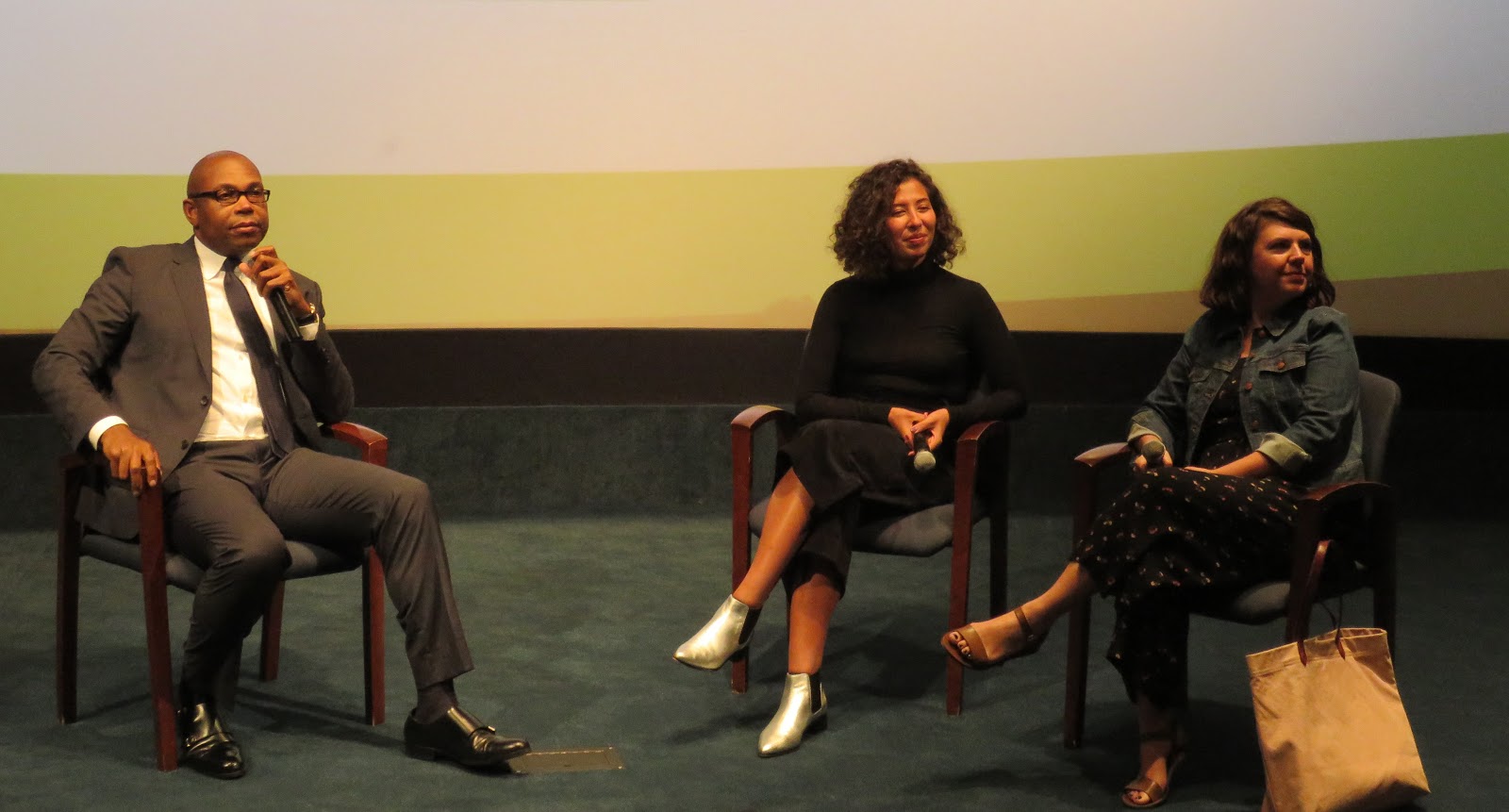
Moderator Ron Nixon, the homeland security
correspondent for The New York Times; Director
Assia Boundaoui; Producer Jessica Devaney

Director Maxim Pozdorovkin; Matt Greenblatt, senior
national correspondent for the Scripps Washington Bureau

Moderator and managing editor at 100Reporters,
Ricardo Sandoval-Palos; Director Heather Courtney;
Senior writer at the Center for Public Integrity,
Susan Ferriss

Moderator and executive producer of Retro Report,
Kyra Darnton; Director Nadia Sussman; Scottish
Freelance journalist, Finlay Young; Kathleen Flynn,
Co-director and Director of Photography; Claudia
Milne, executive producer; Stephen Engelberg, the
founding managing editor of Propublica
UPCOMING next week: My annual pre-Academy Award Random Thoughts/Predictions column including what will win and what should win